


Introduction
Artificial intelligence is transforming how we work and solve problems. But what exactly is AI? How does it differ from traditional computing? And what do you need to know to understand AI discussions?
This module provides a clear, jargon-free foundation for understanding AI fundamentals. You’ll learn what AI is, how it differs from traditional software, and the basic terminology you need to participate in AI conversations.
- What AI is and how it differs from traditional software
- The AI family tree: AI, Machine Learning, and Deep Learning
- Key terminology for understanding AI discussions
The Simple Definition
Artificial intelligence refers to computer systems that can perform tasks typically requiring human intelligence. These tasks include recognising patterns, understanding language, making predictions, and solving problems.
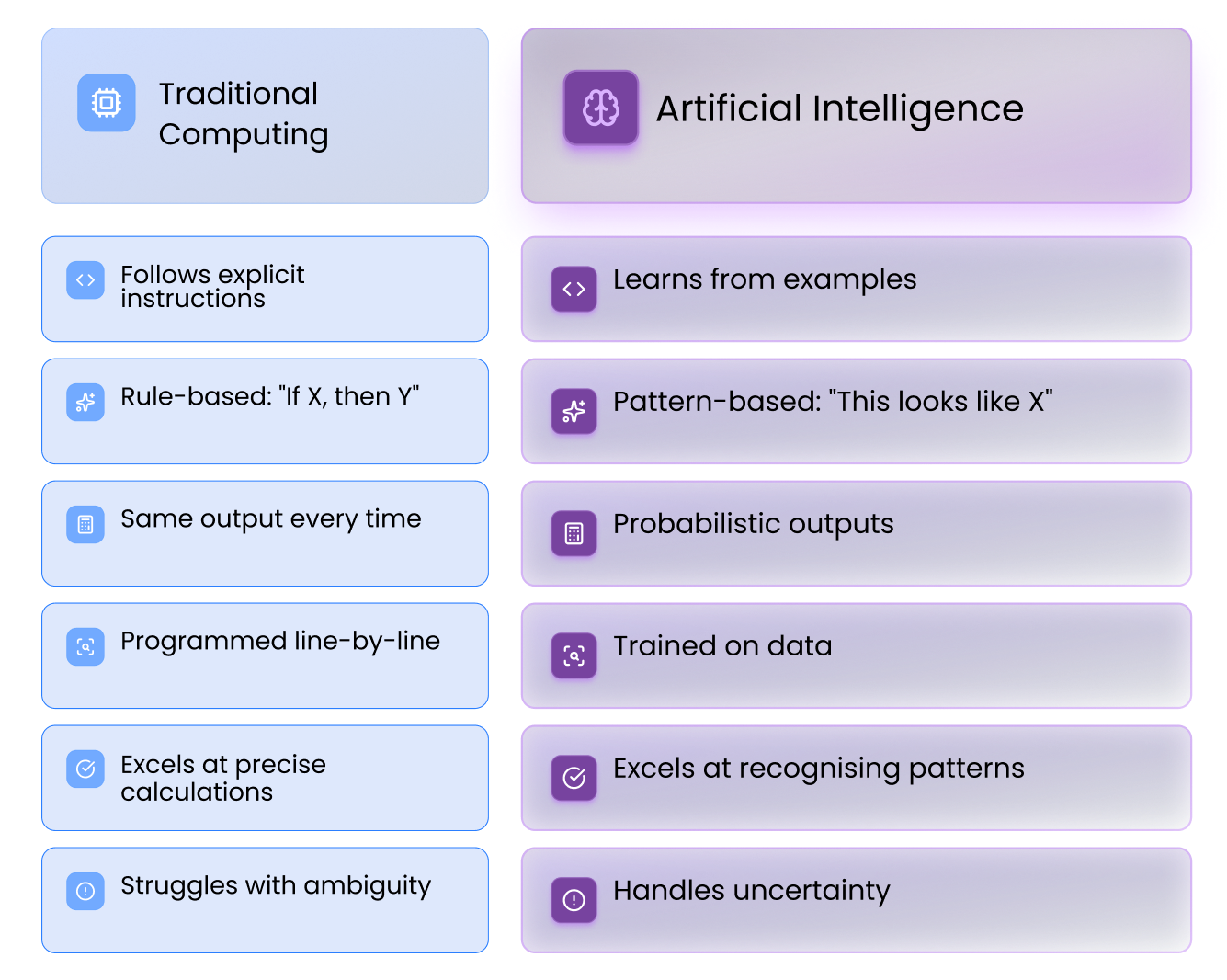
The key difference: AI learns from examples rather than following explicit step-by-step instructions.
Think of it this way:
- Traditional software: Does exactly what a programmer tells it to do
- AI system: Learns what to do by studying thousands of examples
What “Intelligence” Means in AI
When we talk about intelligence in AI, we mean specific capabilities:
- Perception: Recognising and interpreting information (identifying objects in photos, understanding spoken words)
- Learning: Improving performance through experience (getting better at recommendations as it learns your preferences)
- Problem-solving: Finding solutions to challenges (calculating the fastest route considering traffic)
- Reasoning: Drawing conclusions from information (detecting unusual patterns that might indicate fraud)
Traditional Computing vs AI
A Practical Example: Sorting Emails
Traditional Computing Approach:
A programmer writes explicit rules:
- If email contains “invoice” → move to Finance folder
- If email from boss@company.com → mark as important
- If email contains “meeting” + date → add to calendar
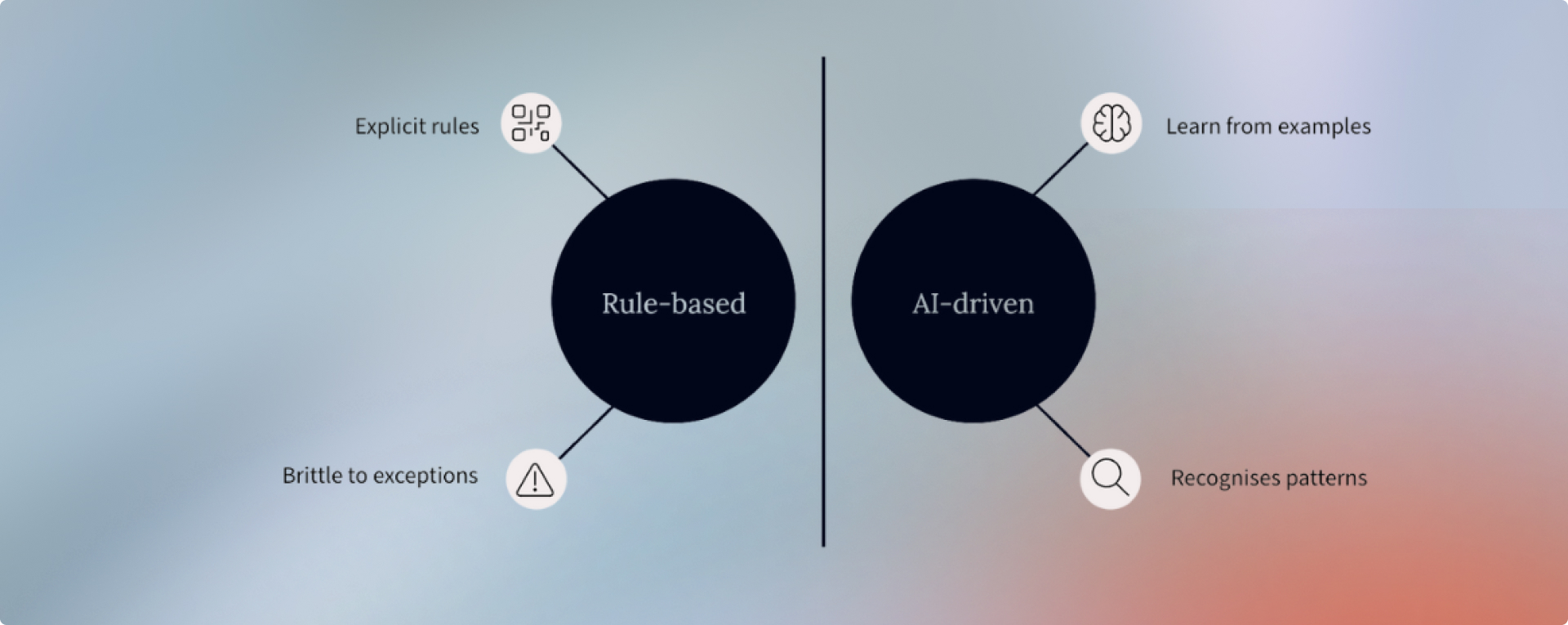
The problem: What happens when an invoice doesn’t contain the word “invoice”? The system fails because it only follows exact rules programmed.
AI Approach:
The AI is trained on thousands of emails humans have already sorted:
- Studies hundreds of invoices and learns what they typically look like
- Notices patterns: formatting styles, sender addresses, number formats, specific keywords
- Learns that invoices vary but share common characteristics
The result: AI recognises invoices even without the word “invoice” because it learned what invoices generally look like.
Understanding AI Today: From Narrow to Capable
Here’s what’s changed recently:
Until recently, AI was strictly “narrow” or task-specific. An AI trained for one job couldn’t do anything else. A chess-playing AI couldn’t recognise images. An image recognition system couldn’t translate languages.
Modern AI has evolved:
Today’s advanced AI systems, particularly large language models and multimodal AI, can handle multiple related tasks:
- Large language models (like GPT-4, Claude, Gemini) can write, translate, analyse data, answer questions, and generate code
- Multimodal AI can process text, images, audio, and video together
- Agentic AI can pursue goals, use tools, make decisions, and chain together different capabilities to complete complex tasks
Important limitations remain:
Despite these advances, modern AI still has significant constraints:
- Domain-specific: AI designed for financial services won’t work for medical diagnosis or architectural design
- Requires training: Each application needs specific training or careful design for its domain
- Cannot truly generalise: Unlike humans who can apply knowledge across completely unrelated fields, AI remains focused on the domains it was trained for
- AGI doesn’t exist: Artificial General Intelligence with human-like general intelligence across all domains remains theoretical
Why This Matters for Financial Services:
Financial services rely heavily on judgement, pattern recognition, documentation, and regulatory compliance, which means AI has a natural role to play. Understanding the difference between narrow AI and more capable modern systems helps explain both the opportunities and the limits.
AI is increasingly used to support activities that involve interpreting information, generating written outputs, and identifying potential risks. For example, AI can review documents, highlight inconsistencies, draft summaries, suggest next steps, and flag unusual patterns in customer behaviour. These systems are well suited to domains like financial advice, operations, customer communication, risk management, and compliance because the tasks follow repeatable patterns and are grounded in structured rules and regulations.
However, it is equally important to understand what AI cannot do. These systems remain domain bound. An AI designed to assist with financial tasks has been trained on financial language, behaviours, and regulatory expectations. It will not perform well in medical diagnosis or engineering design because the knowledge, data, and reasoning patterns are fundamentally different. Even within financial services, an AI built for one purpose, for example fraud detection, will not automatically excel at another without significant additional training or design.
The key point is this: modern AI can now support a broad range of related tasks within a single domain, offering improved efficiency, accuracy, and consistency, yet it has not achieved the kind of general intelligence that would allow it to operate effectively across unrelated fields. Understanding this balance helps set realistic expectations about where AI adds value, where human oversight remains essential, and how to assess new AI tools in a regulated environment.
The AI Family Tree
AI terminology can be confusing because several terms get used interchangeably. Let’s clear this up.
Artificial Intelligence (The Umbrella Term)
What it is: The broadest category covering any computer system that demonstrates intelligent behaviour
Scope: Includes everything from simple rule-based systems to advanced neural networks
Key point: When people say “AI,” they’re referring to this entire family of technologies
Machine Learning (How AI Learns)
What it is: A subset of AI focused on systems that learn from data and improve through experience
The key insight: These systems get better at their task the more examples they see
Three main approaches to learning:
| Supervised Learning | Unsupervised Learning | Reinforcement Learning |
| Learns from labelled examples where the correct answer is provided Example: Email spam filter trained on emails marked “spam” or “not spam” | Finds patterns in data without being told what to look for Example: Customer segmentation discovering natural groups in purchase behaviour | Learns through trial and error, receiving rewards for good actions Example: Game-playing AI that improves by playing thousands of matches |
Note: You’ll explore these learning approaches in detail in Module 2
Deep Learning (The Current Revolution)
What it is: A subset of machine learning using neural networks with many layers
Why “deep”: The “deep” refers to multiple layers of processing, where each layer learns increasingly complex patterns
What makes it powerful:
- Inspired by how human brains process information
- Particularly effective at recognising patterns in images, speech, and language
- Powers many of today’s most impressive AI applications
Why Deep Learning Took Off Recently:
Three things came together to make deep learning practical:
Massive data:
- The internet provided billions of images, texts, and videos
- Social media, smartphones, and digital services generate enormous datasets
- More data means better pattern recognition
Powerful computing:
- Graphics processors (GPUs) made training feasible
- Cloud computing made this power accessible to everyone
- Processing that once took months now takes days or hours
Better algorithms:
- Researchers discovered techniques for training very deep networks
- New methods prevented common training problems
- Innovations continue to improve performance
What Deep Learning Excels At:
- Recognising objects in images and videos
- Understanding and generating human speech
- Processing and creating written language
- Detecting complex patterns in data
Understanding these terms will help you follow AI conversations and make sense of AI-related news.
Algorithm: Set of mathematical rules AI uses to learn patterns from data and make decisions. Think of it as the recipe the AI follows.
Training Data: Examples used to teach AI systems. The quality and diversity of training data largely determines how well the AI performs.
Model: The trained AI system ready to make predictions or decisions. After training on data, the “model” is the finished product you can use.
Neural Network: AI architecture inspired by how neurons in the brain connect and process information. Consists of layers of interconnected nodes that process information.
Natural Language Processing (NLP): AI’s ability to understand and generate human language. Powers everything from virtual assistants to document summarisation.
Large Language Model (LLM): AI trained on vast amounts of text (often billions of words) to understand and generate human language. These models power advanced chat systems and writing assistants.
Multimodal AI: AI that can process and understand multiple types of data (text, images, audio, video) together. Represents a significant advance from single-type AI systems.
Agentic AI: AI systems that can pursue goals, use tools, make decisions, and take actions to complete complex tasks. Can chain together different capabilities intelligently.
Supervised Learning: Training AI using examples where the correct answer is already known. The AI learns to predict the right answer for new examples.
Unsupervised Learning: Training AI to find patterns in data without being told what to look for. The AI discovers groupings and relationships on its own.
Reinforcement Learning: Training AI through trial and error with rewards and penalties. The AI learns which actions lead to the best outcomes.
Deep Learning: Machine learning using neural networks with many layers. Particularly effective for complex tasks like image recognition and language understanding.
Bias: When AI reflects prejudices or unfair patterns present in training data. Can lead to discriminatory outcomes if not carefully addressed.
Hallucination: When AI generates information that sounds plausible but is actually incorrect or fabricated. A particular concern with language models.
Black Box: Refers to AI systems (particularly deep learning) that cannot easily explain their decision-making process in terms humans understand.
What AI Actually Is
- AI learns from examples rather than following step-by-step programming
- Pattern recognition is core – AI excels at spotting patterns in large amounts of data
- Modern AI is domain-capable – Today’s AI can handle multiple tasks within specific domains, but not across all fields
- AGI doesn’t exist – General AI with human-like intelligence across all domains remains theoretical
- Different from traditional computing – AI learns and adapts; traditional software follows fixed rules
The AI Family Tree
- Artificial Intelligence is the umbrella term for all intelligent computer systems
- Machine Learning is how AI learns from data (three main types: supervised, unsupervised, reinforcement)
- Deep Learning uses multi-layered neural networks for complex pattern recognition
- Recent advances came from combining massive data, powerful computing, and better algorithms
Key Vocabulary
- You understand the fundamental terms needed for AI discussions: algorithms, training data, models, neural networks, LLMs, multimodal AI, and agentic AI
- You know the three types of machine learning and when each is used
- You recognise important concepts like bias, hallucinations, and the “black box” problem
What’s Next
Module 2: How AI Learns and Makes Decisions will take you deeper into the mechanics of AI. You’ll explore:
- How the three types of machine learning actually work
- What AI needs to learn (data, algorithms, computing power)
- The training process from start to finish
- How AI makes predictions and decisions
Module 3: AI in the Real World: Applications and Impact will show you AI in action. You’ll discover:
- What AI can and cannot do
- Where you already use AI in daily life
- Real-world applications across industries
- The practical implications for your work
You now have the foundation to understand these more detailed topics. Well done on completing Module 1.