Shape the future of assurance for AI agents, and the human teams that govern them.
A collaborative forum for senior decision makers, risk leaders, and innovators across risk, compliance, and line of defence oversight. It is an opportunity to compare experiences, challenge assumptions, and explore what assurance will look like as organisations start to introduce more autonomous AI.
1 July 2026 | 6pm - 9pm
Haymarket Hotel, 1 Suffolk Pl, London SW1Y 4HX
Welcome
The Agent Assurance Expert Council brings together a small and select group of senior and experienced practitioners who are curious about where assurance is heading as AI systems, deploy rapidly and become more autonomous. We want to help shape that direction together.
This isn’t a product demo or a feature design forum; it’s a space for open, practical conversations. The rapid increase in AI adoption means traditional oversight and assurance processes are not fit for purpose. The scale of effort required to provide meaningful oversight is significant,
compoundedby the emergence of new risk types and understandable high regulatory expectations on its provision. This will impact how organisations are thinking about ownership and accountability and what meaningful assurance could look like in day-to-day operations.
This page acts as a shared home for the Council, with an overview of the purpose, how the group works, what to expect from each session, and a short, anonymised summary of themes and takeaways after every meeting.
The Agent Assurance Expert Council brings together a small and select group of senior and experienced practitioners who are curious about where assurance is heading as AI systems, deploy rapidly and become more autonomous. We want to help shape that direction together.
This isn’t a product demo or a feature design forum; it’s a space for open, practical conversations. The rapid increase in AI adoption means traditional oversight and assurance processes are not fit for purpose. The scale of effort required to provide meaningful oversight is significant, compoundedby the emergence of new risk types and understandable high regulatory expectations on its provision. This will impact how organisations are thinking about ownership and accountability and what meaningful assurance could look like in day-to-day operations.
This page acts as a shared home for the Council, with an overview of the purpose, how the group works, what to expect from each session, and a short, anonymised summary of themes and takeaways after every meeting.
Why this council exists
Agentic AI is noisy, but assurance needs clarity.
Most organisations are at very different stages of readiness. Some are starting out with basic controls for AI assisted processes and some are experimenting with agentic workflows. The spectrum and speed of adoption is uneven, but evolving.
The Council exists to validate what is genuinely changing, what is still hypothetical, and what needs to be true for agentic assurance to become a board-level, regulator accepted, and budgeted priority.
What you'll get out of it
01
Access to industry peers
Compare notes with other practitioners facing similar governance, oversight and assurance challenges.
02
A clearer view of the emerging landscape
Share what you are seeing: buy vs build appetite, current tooling, what is working, what is theatre, where gaps still exist.
03
Useful artefacts, not fluff
Before each session we’ll set the scene. Concisely. After each session, we’ll share an anonymised summary and emerging themes.
What we’ll cover
Where agent-related risk is beginning to surface and how assurance activities needs to evolve.
How might we start to think about deploying appropriate levels of agent-based assurance in a world where we see exponential growth of agents.
How Aveni sees the world, and the evolution of the ‘machine line-of defence’ to address the challenge.
How assurance accountability and responsibilities evolve across 1st and 2nd lines of defence.
Discussion and perspective on how the broader operating model that will need to adjust to adopt a ‘machine line of defence’.
How organisations are framing, funding and buying machine-led assurance capability.
Which problems feel urgent today, and which are still several years out.
How it works?
Cadence
Quarterly sessions, alternating Edinburgh and London.
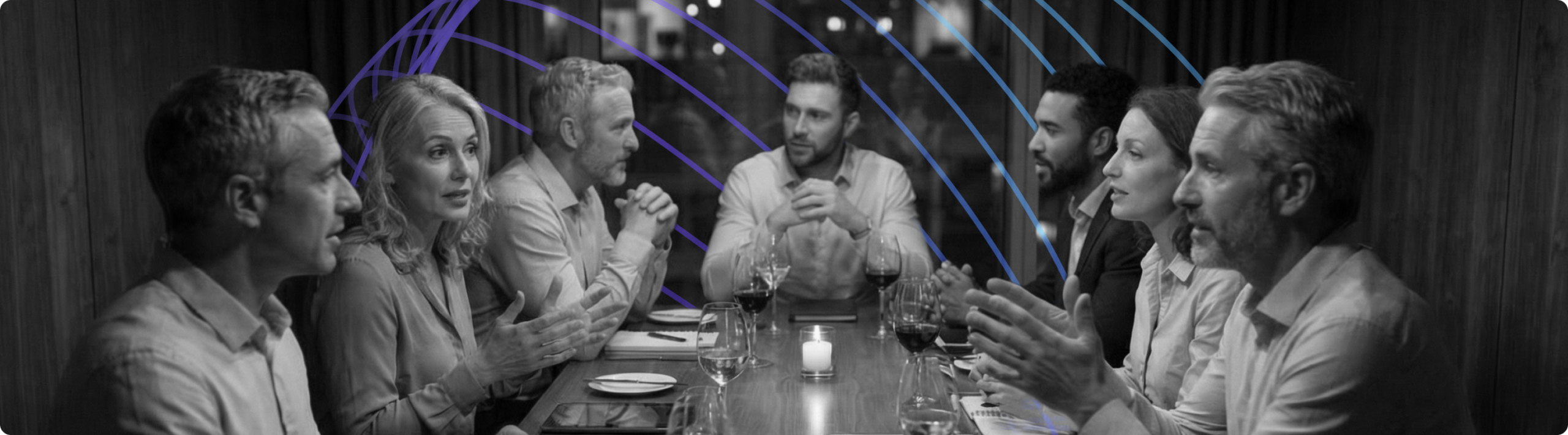
An informal, hosted roundtable dinner with a guided discussion including: a short scene-setter, and key themes for peer exchange.
Chatham House Rules
We capture themes and learnings allowing for candid discussion, not attributions.
Pre-read
A short brief is shared 48 hours before each meeting to provide context for the session and share any introductory material that might be helpful.
Follow-up
A short anonymised summary plus occasional “saw this and thought of you” notes when relevant research, regulation, or market shifts occur.
FAQs
Is this a sales forum?
100%no. The Council is designed to validate the challenge, act as a ‘brain trust’ to agitate, provoke, and discuss where we collectively think the industry needs to go.. We may share hypotheses and invite any challenge.
Will competitors be in the room?
Members typically treat compliance and assurance as non-competitive topics. We curate the room to keep discussion productive and respectful.
Can we share insights internally?
Yes. You can share learnings internally, but we do not attribute comments to individuals or firms.
Continuous improvement
Feedback from reviewers helps tune performance over time, so monitoring becomes more accurate, more consistent and more valuable the more you use it.