

AI tools for suitability report automation in the UK must be purpose-built for financial advice, trained on regulatory requirements and integrated with adviser systems. Generic AI platforms lack the domain knowledge and compliance capabilities UK advisers require.
Essential Features for UK Financial Advice
Effective AI tools for suitability report automation require specific capabilities aligned with FCA requirements and UK advice processes.
COBS 9.4 compliance ensures reports contain all required elements including client circumstances, suitability explanation, product disclosure and risk warnings. The system must understand what information is mandatory and flag gaps.
Consumer Duty alignment means reports communicate clearly in language customers understand. The AI must avoid jargon, explain complex concepts appropriately and ensure customers can make informed decisions.
UK product knowledge covers pensions, ISAs, investment bonds, investment platforms and protection products used in UK advice. Generic AI tools trained on international markets lack understanding of UK-specific products and regulations.
Template compatibility allows the system to work with existing firm formats. UK advisers should continue using familiar templates whilst AI handles content population.
Integration with UK platforms including intelliflo office, Xplan, Salesforce Financial Services Cloud and other CRM systems common in UK advice ensures the AI can access client data and update records automatically.
Domain-Specific Training Requirements
AI tools must be trained specifically on financial advice conversations and documentation to produce accurate, compliant outputs.
Financial services language understanding enables the system to interpret complex advice terminology correctly. Generic AI struggles with concepts like defined benefit pension transfers, crystallisation, uncrystallised funds pension lump sums and other technical terms UK advisers use daily.
Regulatory knowledge embedded in the system ensures appropriate language, required warnings and compliance standards appear in reports automatically. The AI should understand what Consumer Duty requires, when vulnerable customer provisions apply and what disclosures are mandatory.
UK market context including current allowances, tax rates, regulatory changes and product features ensures reports contain accurate, up-to-date information. Systems trained on outdated data or international markets produce incorrect content.
One AI tool built for US financial advisers struggled with UK pension advice because it lacked understanding of lifetime allowances, annual allowances and UK tax treatment. Purpose-built UK tools avoid these gaps.
Meeting Capture and Transcription
High-quality meeting capture forms the foundation of automated suitability report writing.
Platform integration with Microsoft Teams, Zoom, Google Meet and other tools UK advisers use ensures the system can attend meetings easily. One-click invitation or automatic attendance reduces setup friction.
Audio quality optimisation handles varying microphone quality, background noise and multiple speakers. The system should transcribe clearly even in less-than-perfect recording conditions.
Speaker identification distinguishes adviser statements from client responses. This context helps the AI understand who said what and extract information accurately.
Real-time processing allows the system to begin analysis during meetings or immediately after they end. Faster processing enables same-day report delivery.
Information Extraction Capabilities
Effective AI tools identify and extract relevant information from unstructured meeting conversations.
Client circumstances recognition captures financial position, income, expenditure, assets, liabilities, existing provisions and protection needs from natural conversation flow.
Goals and objectives identification understands both explicit statements and implicit priorities expressed during discussions. The system recognises when clients mention retirement plans, education funding, inheritance planning or other objectives.
Risk profile extraction synthesises attitude to risk discussions, capacity for loss assessment and experience considerations into appropriate risk categorisation.
Product discussion documentation records features explored, alternatives considered, charges explained and client questions answered. This provides justification evidence regulators expect.
Context awareness distinguishes between adviser explanations and client circumstances. The system knows that when an adviser explains how pensions work, this is background information, not client data.
Report Generation and Formatting
AI tools must produce properly structured, compliant documentation matching firm standards.
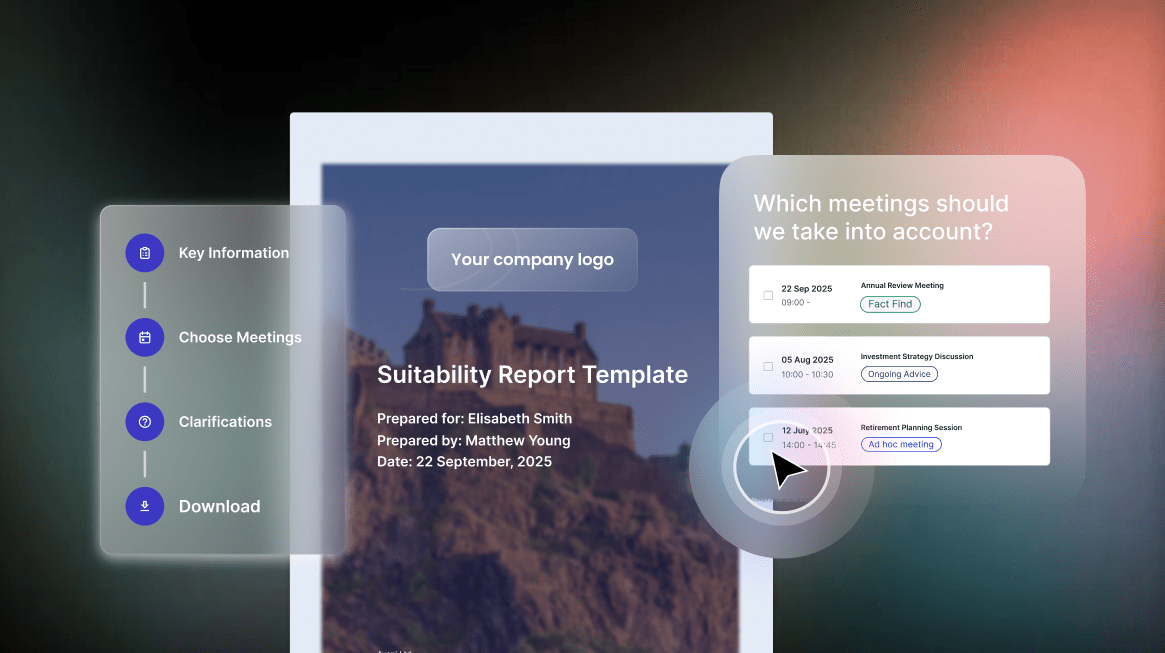
Template population fills firm templates accurately with extracted information. The system places content in appropriate sections, maintains formatting and applies house style.
Regulatory language generation creates compliant explanations, risk warnings and disclosures using FCA-approved phrasing. The AI knows what language is required for different product types and client circumstances.
Suitability justification construction builds clear reasoning chains explaining why recommendations meet needs, how they align with goals and risk profile, and why alternatives were rejected.
Gap identification flags missing information, incomplete sections or weak justification before advisers review reports. This quality control prevents incomplete documentation from reaching clients.
Compliance Checking Features
Built-in compliance verification ensures reports meet regulatory standards before adviser approval.
COBS 9.4 completeness checking confirms all required sections contain information, mandatory elements appear and critical disclosures are included.
Consumer Duty clarity assessment evaluates whether language is appropriate for customer understanding. The system flags jargon, complex sentences or unclear explanations.
Vulnerable customer provisions verify that reports for vulnerable customers contain appropriate adjustments, clearer language or additional support information.
Consistency verification compares report content against CRM data, fact-finds and previous interactions. Contradictions or gaps are highlighted for adviser attention.
Integration and Workflow Capabilities
Seamless integration with existing adviser technology ensures efficient processes.
CRM connectivity pulls client data, updates records and maintains synchronisation between systems. Advisers should not manually transfer information between platforms.
Document management integration files completed reports automatically in appropriate client folders, maintains version history and supports regulatory record keeping.
Back-office platform connections enable straight-through processing from report approval to product implementation. Applications and transfers proceed without re-keying information.
Compliance workflow integration routes reports through required approval processes, tracks review status and maintains audit trails for regulatory purposes.
UK-Specific Compliance Considerations
AI tools for UK advisers must address specific regulatory requirements.
Data protection compliance with UK GDPR ensures client information is handled securely, consent is obtained appropriately and data processing meets regulatory standards.
FCA authorisation verification confirms the vendor is appropriately regulated or works under appropriate permissions. Firms should validate regulatory status before deployment.
Professional indemnity insurance coverage protects against technology failures or errors. Vendors should carry appropriate insurance for the risks their systems create.
Audit trail requirements capture system decisions, data sources and adviser interventions for regulatory reviews. Complete logging supports FCA file examinations.
Training and Support Requirements
Effective AI tools include comprehensive training and ongoing support for UK advisers.
Implementation support covers system setup, template configuration, integration with existing platforms and initial testing. UK-based implementation teams understand local requirements.
Adviser training programmes teach efficient review processes, system capabilities and quality standards. Training should be practical and focused on real advice scenarios.
Compliance guidance helps firms establish governance frameworks, approval processes and quality assurance procedures appropriate for automated report writing.
Ongoing support responds quickly to questions, resolves technical issues and provides updates when regulations change. UK office hours support ensures help is available when advisers need it.
Cost Structures for UK Advice Firms
Pricing models for AI suitability report automation vary by vendor and firm size.
Per-adviser licensing charges typically range from £2,000 to £4,000 annually depending on features and support included. This model suits firms wanting predictable costs.
Per-report pricing charges for each suitability report generated. Costs typically range from £15 to £30 per report. This suits firms with variable report volumes.
Enterprise pricing for large advice networks offers volume discounts and custom features. Networks with 200+ advisers often negotiate bespoke arrangements.
Implementation fees cover setup, integration and training. Expect £30,000 to £60,000 for mid-sized firms, £60,000 to £100,000 for large networks.
Evaluation Criteria
Firms assessing AI tools for suitability report automation should evaluate specific factors.
Accuracy on UK advice scenarios matters more than general capability. Request demonstrations using your actual meeting transcripts and templates to assess real-world performance.
FCA compliance verification requires evidence that reports meet regulatory standards consistently. Ask for compliance officer testimonials and regulatory approval documentation.
Integration capabilities with your specific CRM, back-office and document management systems determine implementation complexity and ongoing efficiency.
Vendor stability and track record in UK financial advice indicate whether the provider will support you long-term. Check client references and years operating in the UK market.
Common Implementation Pitfalls
Firms deploying AI suitability report automation should avoid predictable mistakes.
Choosing generic AI tools not built for UK financial advice creates compliance risk and poor results. Domain-specific solutions deliver substantially better outcomes.
Inadequate template preparation before implementation reduces automation effectiveness. Standardising templates in advance improves draft quality from day one.
Insufficient adviser training leads to low adoption and poor ROI. Comprehensive training on review processes and system capabilities is essential.
Weak governance frameworks allow incomplete or non-compliant reports to reach clients. Clear approval processes and quality standards prevent this risk.
Emerging Capabilities
AI tools for suitability report automation continue evolving with new features.
Real-time guidance during meetings may suggest questions advisers should ask, highlight missing information and recommend next steps based on discussion flow.
Multi-meeting synthesis could combine information from several client interactions into comprehensive reports. Complex advice processes benefit from accumulated context.
Predictive compliance checking might identify potential suitability issues before recommendations are finalised, allowing advisers to address concerns proactively.
Frequently Asked Questions
Do all AI tools for suitability reports work with UK regulations? No. Many AI tools are built for international markets and lack UK-specific regulatory knowledge. Purpose-built UK solutions trained on FCA requirements perform substantially better.
Can we trial AI suitability report automation before committing? Most vendors offer pilot programmes. Expect 4 to 8 week trials with 5 to 10 advisers to assess fit before full deployment.
What happens if the AI generates an incorrect report? Adviser review catches errors before reports reach clients. Well-designed systems flag areas of lower confidence prompting careful human verification.
How long does it take to see results after implementation? Most firms measure time savings within the first month of production use. Full ROI typically occurs within 2 to 3 months.
Discover how Aveni Assist automates suitability reports for UK financial advisers →