


Why a Consumer Duty compliance checklist matters
Since the introduction of Consumer Duty, the Financial Conduct Authority (FCA) has shifted its focus from policy statements, to proof. Firms are now expected to show clear evidence that customers receive good outcomes across products, pricing, communications and support.
For many teams, the challenge is not understanding the rules. It is knowing whether the evidence they hold would stand up during a supervisory review.
This guide provides a practical Consumer Duty compliance checklist you can use as a working tool. It is designed to support internal self-assessment, team workshops and ongoing monitoring. The five sections reflect the FCA’s four outcomes, plus a dedicated evidence and monitoring framework.
If you are new to Consumer Duty, it may help to think of it as a requirement to demonstrate that customers are treated fairly at every stage of the journey, from product design to ongoing service. The FCA does not expect perfection, but it does expect structured oversight and clear records of how decisions are made.
New to evidencing Consumer Duty at scale? Start with the full framework here → The 2026 UK Financial Services Firms’ Guide to Evidencing Consumer Duty at Scale
How to use this Consumer Duty compliance checklist
You can apply this checklist in several ways depending on where your firm is in its Consumer Duty journey.
1. Self-assessment review
Compliance or risk teams can work through each section to identify gaps in existing evidence. This helps prioritise where improvements are needed before an FCA review.
2. Cross-team workshops
Consumer Duty spans product, operations, compliance and customer support. Running a workshop with representatives from each area often reveals differences in interpretation or documentation standards.
3. Ongoing monitoring
The checklist is not intended as a one-off exercise. Many firms use it quarterly alongside management information reports to confirm that monitoring remains consistent.
A common mistake is treating Consumer Duty as a project with a finish line. The FCA expects continuous oversight, supported by data rather than occasional reviews.
Products and Services outcome checklist: showing products meet customer needs
The first outcome focuses on whether products are designed and distributed with a clear target market in mind. Firms should be able to explain who a product is for, who it is not for, and how performance is monitored after launch.
Products and Services checklist
☐ Target market defined using clear criteria
☐ Evidence shows product features match customer needs
☐ Distribution channels reviewed for suitability
☐ Third-party partners assessed for alignment with target market
☐ Product approval process documented
☐ Ongoing monitoring of product performance
☐ Post-sale outcomes reviewed using customer data
☐ Regular governance meetings recorded
☐ Product risks clearly identified and tracked
☐ Changes to product features documented with rationale
☐ Customer complaints linked back to product design insights
☐ Evidence of periodic product reviews
☐ Training provided to staff distributing the product
☐ Marketing materials checked against target audience
☐ Vulnerable customer considerations included in product design
☐ Escalation process in place when outcomes fall short
☐ Target market profiles documented with detail, not just high-level categories
☐ Closed products and services reviewed against the four outcomes
Many firms document product design thoroughly but hold limited evidence of post-sale monitoring. The FCA increasingly looks for proof that products continue to deliver value over time, not just at launch.
Price and Value outcome checklist: evidencing fair pricing
The Price and Value outcome asks firms to demonstrate that customers receive benefits proportionate to what they pay. This goes beyond headline fees and includes service quality, features and overall outcomes.
Price and Value checklist
☐ Pricing methodology documented
☐ Evidence shows benefits compared against costs
☐ Benchmarking conducted against comparable products
☐ Cross-subsidies assessed and explained
☐ Regular value assessments completed
☐ Distribution costs reviewed as part of pricing decisions
☐ Customer groups analysed for fairness
☐ Evidence shows pricing is reviewed periodically
☐ Fee changes tracked with supporting rationale
☐ Senior management oversight documented
☐ Value assessments include customer outcomes data
☐ Communications explain pricing clearly
☐ Evidence that incentives do not create harm
☐ Monitoring identifies customers paying for unused features
☐ Product governance committees review value findings
☐ Decisions documented when pricing concerns arise
A common gap appears when firms rely on historic pricing models without recording how those models were tested against real customer outcomes.
Consumer Understanding outcome checklist: ensuring communications are clear
Consumer Understanding focuses on whether customers can make informed decisions. The FCA expects firms to test communications and demonstrate that information is accessible to different audiences.
Consumer Understanding checklist
☐ Key documents written in clear, plain language
☐ Evidence of readability reviews
☐ Customer testing or feedback recorded
☐ Risk warnings presented prominently
☐ Key features summaries provided
☐ Staff trained on consistent messaging
☐ Communications adapted for vulnerable customers
☐ Digital journeys reviewed for clarity
☐ Evidence that jargon is explained
☐ Monitoring identifies customer confusion or repeat queries
☐ Updates to communications tracked and approved
☐ Marketing claims supported by evidence
☐ Disclosures presented at the right stage of the journey
☐ Call scripts or adviser guidance reviewed regularly
☐ Customer surveys analysed for understanding trends
☐ Governance oversight of communication standards
Some firms hold well-written documents but lack proof that customers actually understand them. Evidence such as interaction monitoring, customer feedback or behavioural insights can help close that gap.
Consumer Support outcome checklist: demonstrating accessible support
The final outcome looks at how firms support customers before, during and after purchase. This includes responsiveness, accessibility and support for vulnerable customers.
Consumer Support checklist
☐ Multiple support channels available
☐ Response times monitored and reported
☐ Evidence shows customers can switch products or cancel easily
☐ Staff trained to identify vulnerability indicators
☐ Escalation paths clearly documented
☐ Complaint handling processes reviewed regularly
☐ Support journeys tested from a customer perspective
☐ Monitoring identifies friction points in service
☐ Evidence of tailored support for vulnerable customers
☐ Accessibility standards applied to digital services
☐ Contact centre scripts reviewed for clarity and fairness
☐ Outcomes tracked following support interactions
☐ Training records show ongoing staff development
☐ Support data integrated into governance reporting
☐ Management reviews customer feedback trends
☐ Evidence shows continuous improvement actions taken
Support is often where Consumer Duty risks emerge first. Interaction monitoring and structured records help firms demonstrate that issues are identified early rather than after complaints escalate.
Evidence and monitoring checklist: meeting FCA evidence requirements
Across all four outcomes, the FCA places strong emphasis on evidence quality. It is not enough to say processes exist; firms need structured, accessible records showing how oversight works in practice.
Evidence and Monitoring checklist
☐ Systematic evidence collection framework in place
☐ Interaction monitoring covers all relevant channels
☐ Evidence stored in a searchable format
☐ Management information produced regularly
☐ Clear audit trail for decisions
☐ Governance meeting minutes documented
☐ Risk indicators tracked over time
☐ Dashboards used to monitor outcomes
☐ Evidence mapped to each Consumer Duty outcome
☐ Sampling approaches supported by wider monitoring
☐ Data sources clearly defined
☐ Evidence retained in line with policy
☐ Internal reviews scheduled regularly
☐ Accountability roles documented
☐ Technology supports consistent monitoring
☐ Board challenge documented in minutes, not just board sign-off
☐ Action plans include named owners, deadlines, and defined success metrics
☐ MI thresholds documented with rationale for why levels were set where they are
| A note on board reporting. The FCA reviewed 180 firms’ first annual Consumer Duty board reports and found a recurring gap: boards approving reports without documented evidence of challenge. Good practice includes a board tracker showing requests made during the year, changes to MI thresholds, and progress on actions. The board’s role is not to sign off the report. It is to scrutinise it. |
A recurring issue in FCA reviews is unstructured evidence. Notes spread across systems or stored as static documents can make it difficult to demonstrate oversight. Structured monitoring, supported by data, helps create a clear narrative of how outcomes are managed.
This checklist forms part of our wider guide to evidencing Consumer Duty outcomes. Explore the full approach → Financial Services Essential Guide to Complete Consumer Duty Coverage in 2026
What “good” looks like during a Consumer Duty FCA review
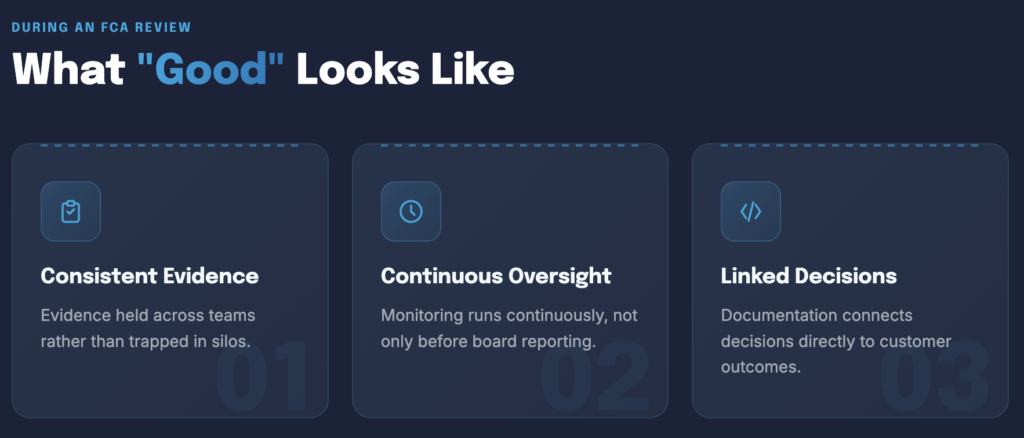
Firms that perform well during supervisory engagement typically show three characteristics:
- Evidence is consistent across teams rather than held in silos
- Oversight happens continuously, not only before board reporting
- Documentation links decisions to customer outcomes
What often fails quietly is reliance on partial evidence, such as reviewing a small sample of customer interactions or relying solely on complaints data. These approaches can overlook patterns that only appear at scale.
Where to start strengthening your Consumer Duty evidence
If your firm is early in its Consumer Duty journey, start with a structured self-assessment using the Consumer Duty compliance checklist above. Identify areas where evidence is unclear or difficult to access. From there, focus on building monitoring processes that run continuously rather than periodically.
Many firms find that improving evidence quality does not require entirely new processes. Often it is about making existing oversight more consistent, more structured and easier to demonstrate.
Read the full guide to evidencing Consumer Duty at scale:
Firms of all sizes are expected to meet the Consumer Duty evidence standard, but the FCA recognises that smaller firms face different constraints. Proportionate approaches are acceptable. Smaller firms may draw on qualitative feedback from staff and customers, data from trade bodies, and input from a knowledgeable external reviewer to fill gaps where formal MI is limited. What matters is that those approaches are structured, documented, and genuinely inform conclusions about customer outcomes.