


Protection insurance is often one of the first areas where Consumer Duty weaknesses surface.
These products are designed for serious illness, injury, death, or loss of income. They are long term, emotionally sensitive, and technically complex. When misunderstandings occur, the consequences usually appear at claim stage, not at point of sale.
Consumer Duty is the FCA’s standard for how firms treat retail customers. It requires firms to demonstrate that customers receive fair outcomes across the full journey, including product understanding, suitability, support, and claims handling. In protection insurance, each of those stages carries elevated risk.
This is why protection insurance frequently becomes a pressure point in Consumer Duty reviews, particularly where firms struggle to evidence outcomes consistently across sales, servicing, and claims.
Why protection insurance faces unique Consumer Duty scrutiny
Product complexity increases the risk of misunderstanding
Consumer Duty protection insurance includes technical features that many customers encounter only once or twice in their lives. Exclusions, waiting and deferral periods, underwriting decisions, medical disclosures, and detailed claim definitions can be difficult to explain clearly.
If those features are not properly understood, the risk is not simply dissatisfaction. It is a poor outcome at the moment the customer needs the product most.
The FCA has repeatedly emphasised the importance of consumer understanding in insurance. Clear communication is not optional. Firms must be able to show that customers understood what they were buying and what would happen at claim stage.
Vulnerability is common in protection journeys
Vulnerability in Consumer Duty protection insurance is not unusual or exceptional. It is embedded in the context of the product itself.
Customers often seek protection because of:
- health concerns or medical diagnoses
- financial strain or job insecurity
- bereavement or caring responsibilities
- major life events such as pregnancy, divorce, or buying a home
These situations affect how people process information and make decisions. That increases the responsibility on advisers to adjust pace, language, and approach. From a Consumer Duty perspective, firms must be able to evidence that vulnerability was identified and handled appropriately.
Claims handling turns promises into outcomes
Protection insurance can feel intangible during the life of the policy. Customers may pay premiums for years without claiming. The true test of value comes at claim stage.
In February 2026, the FCA’s Insurance Regulatory Priorities report placed clear emphasis on improving consumer understanding, claims handling, and service quality. The regulator has also continued its work following the Which? super-complaint on claims handling standards.
For protection insurance, this focus is significant. Even where advice was suitable, a poor claims journey can still result in poor outcomes.
For a full breakdown of what the FCA now expects firms to evidence across all four Consumer Duty outcomes, see our complete guide →Why “Reasonable Steps” Are No Longer Enough: Evidencing Consumer Duty at Scale
Protection insurance failures under Consumer Duty
When Consumer Duty weaknesses emerge in protection insurance, they usually do so at predictable pressure points. These failures are rarely about intent. They are typically about weak evidence, inconsistent processes, or gaps in oversight.
1. Sales complexity: needs, suitability, and decision pressure
Protection conversations often move quickly from identifying risk to selecting products. That speed increases the risk that needs are assumed rather than properly assessed.
Common weaknesses in Consumer Duty protection insurance include:
- cover amounts based on simple rules of thumb rather than documented need
- limited explanation of alternative product options
- unclear links between customer priorities and final recommendations
- subtle pressure to conclude discussions quickly due to the sensitive nature of the topic
In a Consumer Duty review, what matters is evidence. Firms should be able to demonstrate:
- what the customer was trying to protect
- what options were considered
- why the recommendation was appropriate
- how key trade-offs were explained
Without that structure, suitability may appear thin, even if the advice was reasonable.
2. Health disclosure and vulnerability handling
Health disclosure discussions are sensitive by nature. Customers may feel anxious, embarrassed, or unsure about medical terminology. Some may withhold information unintentionally.
Risk increases when:
- technical terms are used without checking understanding
- customers agree quickly without engagement
- vulnerability indicators are present but not recorded
- disclosure conversations are rushed
Under Consumer Duty, firms must be able to show that customers understood why disclosure matters and what the consequences of inaccuracies could be. Evidence should also show that advisers adapted their approach where vulnerability was apparent.
3. Claims handling under stress
Claims are often made during periods of grief, illness, or financial strain. This is a predictable vulnerability peak in protection insurance.
Failures typically appear as:
- delays or inconsistent communication
- unclear documentation requests
- inconsistent outcomes across similar cases
- limited support for vulnerable claimants
The FCA’s priorities highlight the importance of prompt, fair, and transparent claims handling. For insurers and intermediaries using third-party claims handlers, oversight remains a regulatory expectation.
The FCA’s review of board reports found that some firms provided no evidence that good outcomes were being delivered through outsourced consumer support. Firms cannot delegate regulatory responsibility to third parties. For protection insurers using third-party claims administrators, board reports should include specific examples of how TPA performance is monitored, covering call monitoring records, ratings, and indicators of process failure. Oversight of the claims journey is a regulatory expectation, not an internal governance preference.
A suitable sale does not compensate for a poor claims journey.
These failure patterns tie directly to structural evidence gaps that affect firms across financial services, not just protection. See the full picture → Evidencing Consumer Duty at Scale
Where Consumer Duty compliance breaks down in protection insurance
In practice, protection insurance Consumer Duty issues often arise from evidence gaps rather than overt misconduct.
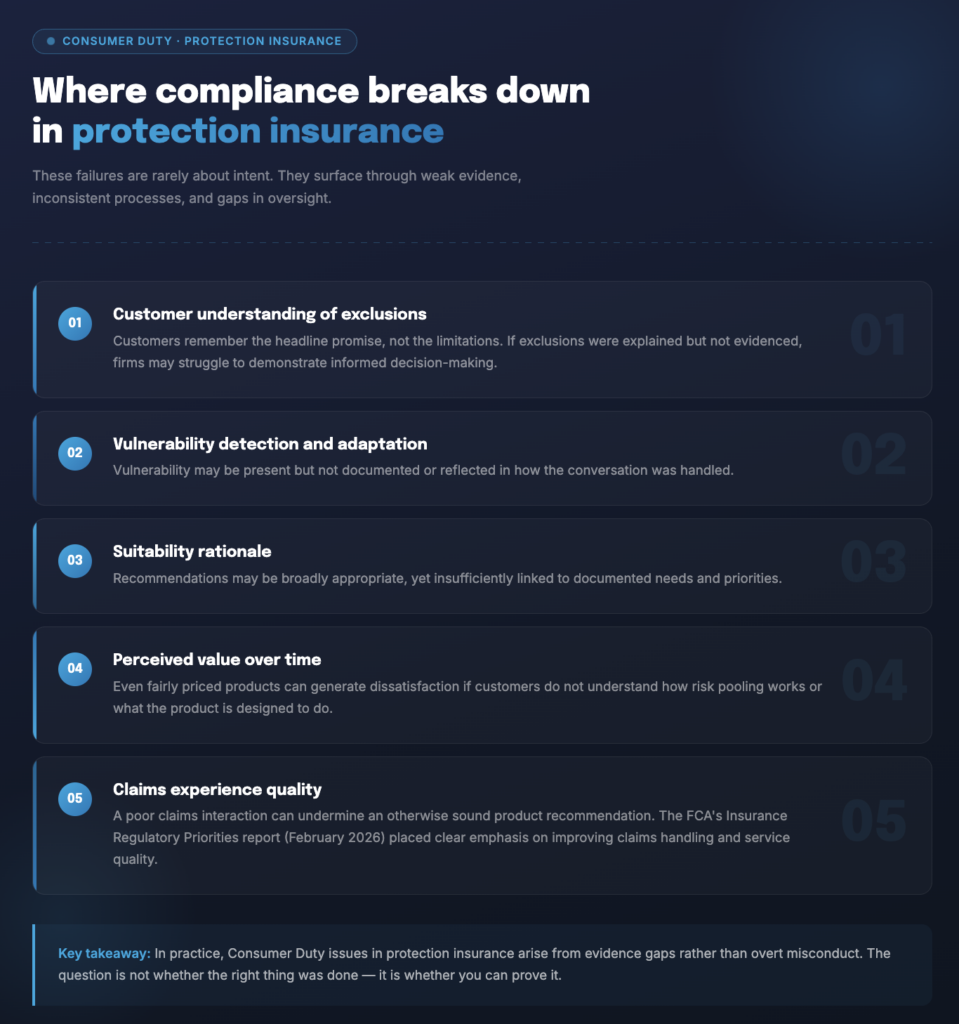
Recurring weak spots in Consumer Duty protection insurance include:
Customer understanding of exclusions
Customers often remember the headline promise, not the limitations. If exclusions were explained but not evidenced clearly, firms may struggle to demonstrate informed decision-making.
Vulnerability detection and adaptation
Vulnerability may be present but not documented or reflected in how the conversation was handled.
Suitability rationale
Recommendations may be broadly appropriate, yet insufficiently linked to documented needs and priorities.
Perceived value over time
Even fairly priced products can generate dissatisfaction if customers do not understand how risk pooling works or what the product is designed to do.
Claims experience quality
A poor claims interaction can undermine an otherwise sound product recommendation.
Why traditional monitoring struggles in the protection sector
Many firms continue to rely on sampling, complaint-driven review, and manual file checks. Those approaches provide partial visibility, but protection journeys are long, complex, and emotionally sensitive.
Sampling a small percentage of interactions makes it difficult to evidence consistent outcomes across thousands of conversations. Complaint data reflects issues after harm has surfaced. File reviews may not capture tone, hesitation, or vulnerability signals present in live conversations.
This is where protection insurance presents a particular challenge under Consumer Duty: firms must evidence outcomes across the full journey, not just at isolated checkpoints.
These monitoring gaps sit at the core of the Consumer Duty evidence problem across financial services. See how firms can build a more complete framework → Evidencing Consumer Duty at Scale
Technology approaches to protection-specific Consumer Duty monitoring
Consumer Duty protection insurance journeys generate substantial evidence, but it is often fragmented across calls, notes, emails, and claims records. Monitoring coverage and consistency therefore matter.
Technology-supported monitoring can help firms strengthen oversight in areas where protection insurance failures are most likely.
Monitoring vulnerability in health-related conversations
Systems can identify language linked to distress, confusion, or low resilience. They can highlight situations where advisers may need to slow down or adapt their approach, and flag cases where vulnerability support actions are not clearly documented.
Monitoring suitability and explanation quality
Monitoring can check whether needs assessments are clearly linked to recommendations and whether key trade-offs were explained. It can also identify patterns of rushed closing behaviour or repeated customer confusion.
Monitoring claims interactions
Claims monitoring can track delays, communication gaps, escalation patterns, and support provided to vulnerable claimants. Over time, this allows firms to identify systemic weaknesses rather than isolated errors.
For a broader view of how monitoring supports Consumer Duty evidence across product design, pricing, consumer understanding, and support, see the full framework →Evidencing Consumer Duty at Scale
What still requires human oversight in Consumer Duty protection insurance
Monitoring does not replace judgement.
Protection insurance still requires human decision-making in:
- complex or unusual cases
- remediation and customer outcome decisions
- adviser training and capability development
- governance and distribution strategy
The practical objective is stronger coverage and clearer evidence, while maintaining accountability with the appropriate individuals and committees.
Practical next steps for protection insurance teams
Firms reviewing their protection insurance Consumer Duty position should consider:
Map outcome pressure points
Identify where outcomes are won or lost across sales, servicing, and claims.
Assess evidence quality
Look for areas where evidence exists but is inconsistent, unstructured, or difficult to retrieve.
Prioritise vulnerability-heavy interactions
Health disclosures and claims conversations often present the highest risk.
Align monitoring outputs with management reporting
Trend data over time is more persuasive in a review than isolated case examples.
Protection-specific Consumer Duty monitoring
Protection insurance combines complexity, vulnerability, and long-term customer impact. Monitoring approaches must reflect that reality.
If you support protection advice or claims journeys, explore how monitoring can strengthen evidence across the full customer journey → Book a demo
For a broader view of building Consumer Duty evidence across products and services → Guide to Evidencing Consumer Duty at Scale