


For years, many financial services firms reviewed a small percentage of customer interactions as part of quality assurance. Listening to one or two calls out of every hundred was considered a practical way to check standards.
Consumer Duty has changed how that approach is viewed.
The FCA now expects firms to show clear evidence that customers are receiving good outcomes. That expectation shifts the focus away from occasional checks and towards consistent oversight.
Consumer Duty sampling is not prohibited. But relying on very small samples can leave large gaps in what a firm actually sees.
When only a fraction of conversations are reviewed, most customer experiences remain invisible. That creates risk, particularly when outcomes depend on how advisers explain information, identify vulnerability or respond to hesitation during a discussion.
This article looks at where sampling still has value, where it falls short, and what more comprehensive monitoring looks like in practice.
What Consumer Duty outcomes can be monitored through customer interactions
Not every aspect of Consumer Duty sits inside a conversation. However, many of the areas that influence real customer outcomes happen during calls, meetings or digital exchanges.
Monitoring interactions can provide evidence in several key areas:
- Vulnerability detection Customers often reveal signs of vulnerability through tone, hesitation or personal circumstances. Reviewing interactions helps firms confirm whether advisers respond appropriately.
- Consumer understanding One of the FCA’s core expectations is that customers understand the products they are considering. Conversations show whether explanations are clear and whether customers ask repeated clarification questions.
- Suitability and appropriateness When advice is given, interactions show how options are presented and whether recommendations align with customer needs.
- Indicators of good outcomes Positive signals such as informed decision-making or confident customer responses can be captured during interactions.
- Fair treatment Language used by advisers, the pace of conversations and how objections are handled all contribute to fair treatment.
These areas sit at the heart of Consumer Duty because they directly influence the customer experience.
What Consumer Duty requirements cannot be monitored through interactions alone
Interaction monitoring is only one part of the wider Consumer Duty framework. Some requirements sit outside individual conversations and require different forms of oversight:
- Product governance decisions made during design and approval stages
- Pricing structures and value assessments
- Board-level governance and senior management oversight
- Management information and reporting frameworks
Interaction monitoring supports evidence gathering, but it cannot replace structured governance processes.
AI enables 100% monitoring of customer interactions and advice quality. Other Consumer Duty requirements such as product design, pricing governance and board oversight require separate approaches.
Why 2 to 5 percent Consumer Duty sampling is insufficient
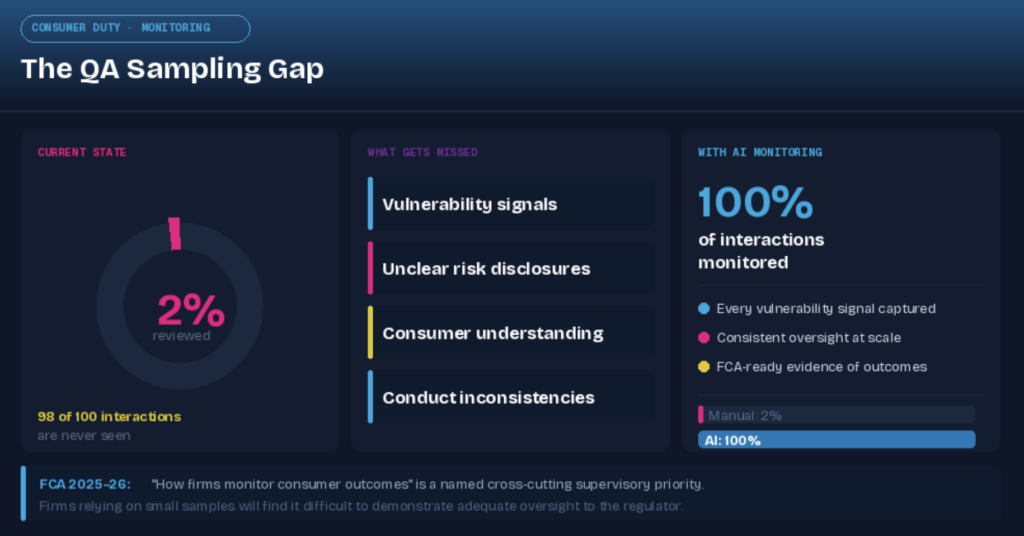
Traditional QA programmes often review between 1 and 5 percent of interactions. That model developed when manual listening was the only viable method.
Under Consumer Duty, expectations around oversight have changed significantly.
The FCA increasingly looks for evidence that firms understand outcomes across their customer base, not only within a limited sample. Its June 2024 multi-firm review of insurance firms found that many were “overly focused on process completion rather than on outcomes” and criticised firms for simply repackaging existing data rather than developing meaningful outcome monitoring. The review also found that “relying solely on complaints data places undue responsibility on customers to identify issues.” In other words, it’s a warning that applies equally to sampling-only approaches.
A low sample rate creates a large blind spot. If only two conversations out of one hundred are reviewed, the remaining ninety-eight go unseen. Patterns such as inconsistent explanations, missed vulnerability signals or unclear risk disclosures may remain hidden.
Sampling also introduces randomness. Even a well-designed sample cannot guarantee that higher-risk conversations are captured.
Examples of issues commonly missed outside small samples include:
- Advisers rushing through risk explanations during busy periods
- Customers expressing uncertainty that does not result in a complaint
- Repeated confusion around pricing or policy features
- Early signs of vulnerability that escalate later
These patterns often emerge only when monitoring is applied consistently across interactions.
The regulatory risk of relying on Consumer Duty sampling
Relying on sampling alone creates real exposure during supervisory reviews, and the FCA is making that increasingly clear.
In its Consumer Duty focus areas for 2025–2026, the FCA explicitly named “how firms monitor consumer outcomes” as one of four cross-cutting review projects. It stated: “Firms should expect a general focus on their implementation and embedding of the Consumer Duty and customer outcomes as part of any supervisory engagement.”
The FCA’s review of board reports identified a related problem. Even where firms had MI in place, many failed to document why thresholds were set where they were. Boards reviewing those reports could not assess whether the boundaries between good and poor outcomes were reasonable. A sampling programme that produces a pass rate has the same gap if the firm cannot explain what a pass means, or why the threshold was set at that level. The number itself is not evidence. The reasoning behind it is.
In January 2026, Enforcement Watch 1 confirmed that six active investigations into potential Consumer Duty breaches are now under way. “Inadequate oversight” is listed as one of seven enforcement priority areas, with the FCA explicitly investigating “systems and controls failings where authorised firms may have caused harm through inadequate oversight.”
The regulatory precedent for inadequate interaction monitoring pre-dates Consumer Duty, but it is instructive. In 2019, the FCA fined Standard Life Assurance Limited £30.7 million after finding it “failed to put in place adequate controls to monitor the quality of calls between its call handlers and non-advised customers.” Call monitoring was found to be insufficient to identify potential poor customer outcomes, and Standard Life paid approximately £25.3 million in redress to over 15,000 customers. Under Consumer Duty’s higher monitoring standards, the bar for adequate oversight is higher still.
In practice, the FCA focuses on how firms demonstrate adequate oversight which means firms need to show that their monitoring processes provide a reliable picture of customer outcomes. When evidence rests on a small number of reviewed interactions, that becomes difficult to demonstrate.
Common documentation gaps include:
- Limited explanation of how samples are selected
- Lack of evidence linking monitoring results to real outcomes
- Inconsistent records across teams
- Difficulty showing trends over time
Consumer Duty sampling still has value for detailed coaching or deep reviews. The risk arises when it becomes the primary source of Consumer Duty evidence.
→ For a broader framework on evidencing outcomes at scale, explore the full guide here: Why ‘Reasonable Steps’ Are No Longer Enough: Evidencing Consumer Duty at Scale
Why vulnerability makes the case for wider coverage
The FCA’s Financial Lives 2024 Survey found that 49% of UK adults (26.4 million people) show one or more characteristics of vulnerability. Vulnerability is common, and it shows up across every customer segment.
But firms often do not know who needs extra care. The FCA’s 2025 multi-firm review on the treatment of vulnerable customers found that only 42% of vulnerable consumers had disclosed their circumstances to any of their financial services providers. Only 19% said they were encouraged to do so by the firm.
That creates a monitoring gap. If vulnerability is not disclosed, firms cannot rely on flags in CRM records or customers asking for help to trigger the right response. They need to pick up signals within conversations, such as confusion, stress, health impacts, bereavement, or financial pressure.
This is also where complaints risk increases. The Financial Ombudsman Service considers whether a firm was aware, or ought reasonably to have been aware, that a customer was vulnerable when assessing complaints.
If only a small fraction of interactions are reviewed, many of those signals will never be seen. Wider coverage gives firms a stronger basis to identify vulnerability earlier, respond consistently, and evidence the decisions they made.
How AI enables 100 percent coverage of monitorable interactions
Advances in speech and language technology mean firms can now analyse large volumes of conversations in a structured way.
The aim is not to replace human reviewers. It is to make monitoring more consistent and to highlight where attention is needed.
The economic case for full coverage
Manual monitoring takes time and grows in cost as volumes increase. Expanding sample sizes usually means adding more reviewers, which does not scale well.
AI-supported monitoring allows firms to assess every interaction against defined indicators, such as vulnerability signals or clarity of explanations. Human reviewers can then focus on higher-risk cases surfaced by the system.
Technology approaches
- Automated transcription and structured analysis of conversations
- Detection of sentiment shifts or hesitation patterns
- Tagging of key events during a call or meeting
- Dashboards showing trends across teams and time periods
What full coverage looks like in practice
Full coverage does not remove human judgement. It reduces blind spots. Teams still review flagged interactions, provide coaching, and decide what action is required.
Cost comparison
Implementing monitoring technology requires investment. As volumes grow, many firms find the cost per interaction falls compared with manual Consumer Duty sampling, because the same infrastructure can analyse every conversation without increasing headcount at the same rate.
See how Aveni Detect delivers full-coverage monitoring →
What still requires human oversight under Consumer Duty
Even with comprehensive monitoring, human judgement remains essential.
Areas that continue to rely on experienced professionals include:
- Complex edge cases where context matters
- Decisions about adviser conduct or remediation
- Training and coaching conversations
- Strategic governance and policy setting
Technology helps surface insights, but accountability remains with people.
Moving beyond Consumer Duty sampling
Transitioning away from heavy reliance on sampling does not need to happen overnight.
Many firms begin by expanding coverage in areas with higher risk exposure, such as advice calls or complex product discussions. Over time, monitoring frameworks can become more systematic.
Practical steps include:
- Mapping which outcomes can be evidenced through interactions
- Identifying gaps where monitoring coverage is low
- Introducing structured tagging or analysis of conversations
- Aligning monitoring outputs with governance reporting
For a wider view of how monitoring fits into evidencing Consumer Duty outcomes, explore the full framework here → How to Evidence Consumer Duty at Scale: 2026 Guide
Calculate your Consumer Duty evidence gap
If your QA programme currently reviews a small percentage of interactions, it may be useful to estimate how much of your customer experience remains unseen.
Understanding that gap helps prioritise where monitoring improvements could reduce risk and strengthen evidence.