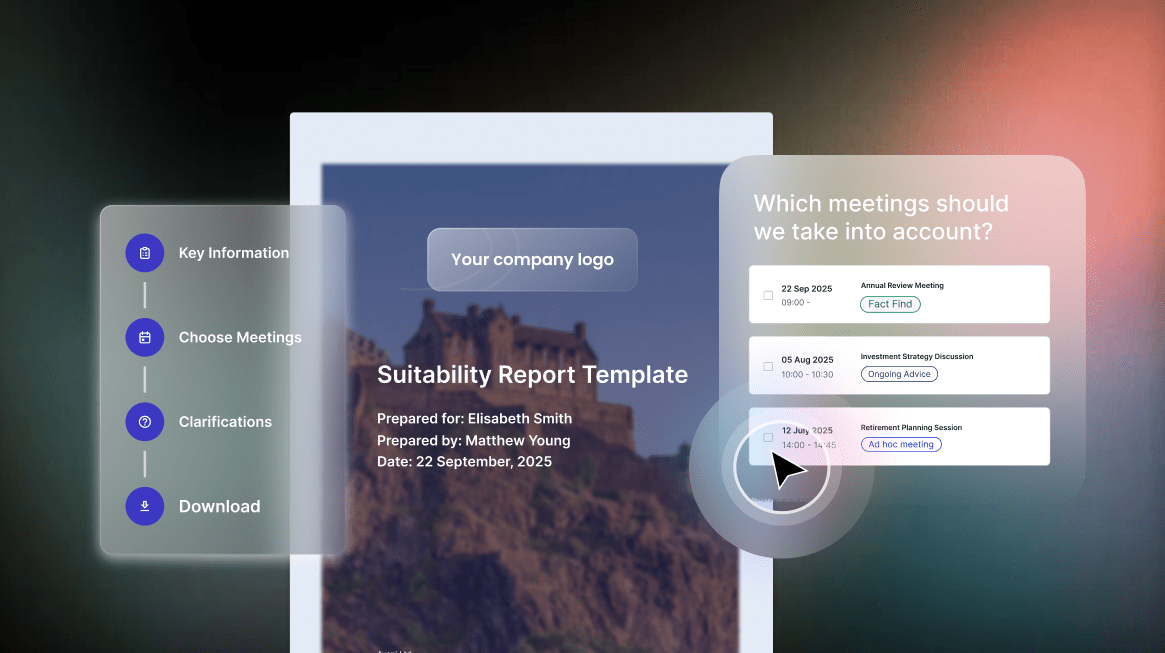


AI-generated suitability reports must meet the same FCA regulatory standards as manually created documentation. This includes COBS 9.4 requirements for content, Consumer Duty obligations for clarity and Treating Customers Fairly principles for appropriate advice.
Core COBS 9.4 Requirements
The FCA’s COBS 9.4 rules specify what suitability reports must contain regardless of creation method.
Client demands and needs including financial situation, knowledge and experience, and objectives must be clearly documented. AI systems must extract and present this information comprehensively from client meetings.
Reason for suitability requires explanation of why recommendations meet client needs, how products align with circumstances and why alternatives were rejected. AI-generated justification must demonstrate clear reasoning chains.
Disadvantages of recommended products must be stated appropriately. AI systems need to identify and communicate relevant drawbacks, limitations and risks.
Product information including charges, surrender values, projected returns and other material facts must be included. The AI must ensure clients receive all required disclosures.
Risk warnings appropriate to product type and client circumstances must appear prominently. AI systems must apply correct warnings based on recommendation specifics.
One compliance team reviewing AI-generated reports found they contained all COBS 9.4 required elements more consistently than manually created documentation where advisers occasionally omitted sections.
Consumer Duty Clarity Standards
Consumer Duty raises expectations for how suitability reports communicate with customers.
Plain language requirements mean reports must avoid jargon, explain complex concepts clearly and ensure customers can understand advice. AI systems must generate accessible content.
Appropriate presentation for customer circumstances requires considering vulnerability, financial capability and previous experience. AI must adjust language complexity based on client profiles.
Check for understanding evidence shows customers comprehend recommendations. AI systems should document comprehension discussions and flag when understanding appears uncertain.
Enabling informed decisions means customers receive sufficient, clear information to make choices confidently. AI-generated reports must provide decision-making context not just product descriptions.
Human Oversight Requirements
The FCA expects firms to maintain accountability for AI-generated suitability reports through appropriate human review.
Adviser approval before client delivery is mandatory. AI generates draft reports but qualified advisers must review, verify and approve final documentation before clients receive it.
Amendment capability allows advisers to refine language, add personal observations, adjust recommendations and include additional context. The system should support efficient editing.
Approval documentation records who reviewed reports, when approval occurred and what changes were made. This audit trail supports regulatory reviews.
Escalation for complex cases ensures reports involving vulnerable customers, large investments or unusual circumstances receive enhanced review. AI systems should flag these situations automatically.
One firm requires senior adviser or compliance officer approval for AI-generated reports exceeding £100,000 investment value or involving vulnerable customers.
Data and Training Requirements
AI systems generating suitability reports must be trained appropriately to understand UK regulatory requirements.
Financial services training data should include actual advice conversations, compliant suitability reports and regulatory guidance. Generic AI trained on general business writing lacks necessary domain knowledge.
Regulatory alignment means the system understands current FCA rules, Consumer Duty obligations and sector-specific requirements. Training data must reflect up-to-date regulations.
UK market context including tax treatment, allowances, product features and regulatory changes ensures accurate content. Systems trained on international data produce incorrect UK advice documentation.
Continuous learning processes update the system as regulations evolve and new compliance expectations emerge. Static AI becomes outdated as requirements change.
Audit Trail and Documentation
Comprehensive audit trails demonstrate appropriate oversight of AI-generated suitability reports.
Data sources used by the AI must be logged including meeting transcripts, CRM data, fact-finds and other information informing report content. This shows the evidential basis for recommendations.
AI decision documentation records how the system reached conclusions, what logic was applied and what confidence levels were assigned. This reasoning trail supports regulatory review.
Adviser interventions including edits, additions and approval decisions must be captured. The audit trail shows human involvement at appropriate stages.
Quality assurance records from compliance reviews, sample audits and performance monitoring provide evidence that firms verify AI system reliability over time.
Error Handling and Correction
Systems must handle AI errors appropriately to prevent incorrect information from reaching clients.
Confidence scoring allows the AI to indicate uncertainty about specific content. Low confidence sections receive enhanced human review.
Automatic flagging highlights potential issues including missing information, weak justification, inconsistencies or unusual recommendations. Advisers address flagged items before approval.
Correction processes enable advisers to fix errors and provide feedback improving future performance. The system should learn from corrections.
Version control maintains records of draft reports, edits and final approved versions. This documentation supports audit requirements.
One AI system flags approximately 15% of draft reports for enhanced review due to detected gaps or lower confidence, preventing potential issues from reaching clients.
Vulnerable Customer Provisions
AI-generated suitability reports for vulnerable customers require additional compliance considerations.
Vulnerability detection in meeting transcripts should trigger enhanced report review. The AI must identify signals including financial difficulty, health issues, comprehension problems or life events.
Adjusted communication for vulnerable customers may require clearer language, additional explanations, simplified structures or enhanced risk warnings. AI systems must recognise when adjustments are appropriate.
Support documentation records how vulnerability was identified, what adjustments were made and why approaches were appropriate. This evidence shows compliance with Treating Customers Fairly principles.
Specialist review for vulnerable customer reports ensures appropriate experts verify that documentation meets their specific needs. AI-generated drafts undergo more thorough human oversight.
Product Disclosure Requirements
AI-generated reports must include all product-specific disclosures FCA rules require.
Charges and costs must be presented clearly including ongoing charges, transaction costs, exit penalties and service fees. AI systems must ensure complete fee disclosure.
Risk categorisation appropriate to product type must appear prominently. Different products require different risk warnings and the AI must apply correct templates.
Tax treatment relevant to the product and client circumstances should be explained clearly. AI-generated content must be accurate for current tax rules.
Performance scenarios where required for certain product types must be included with appropriate assumptions and warnings. The AI must apply regulatory calculation standards.
Quality Assurance Processes
Firms must implement quality assurance verifying AI-generated suitability report compliance over time.
Sample audits reviewing percentages of AI-generated reports ensure ongoing quality. Most firms audit 5% to 10% of reports quarterly.
Compliance exception tracking identifies recurring issues requiring system refinement. Patterns in adviser corrections or audit findings guide improvement priorities.
Regulatory alignment reviews verify reports continue meeting FCA standards as rules evolve. Periodic checks ensure the AI adapts appropriately to regulatory changes.
Client complaint analysis relating to AI-generated reports indicates whether customers understand documentation and feel appropriately advised.
Third-Party AI Vendor Responsibilities
Firms using third-party AI for suitability report generation must ensure vendors meet appropriate standards.
Regulatory understanding of UK requirements is essential. Vendors must demonstrate knowledge of COBS 9.4, Consumer Duty and relevant FCA guidance.
Data security and UK GDPR compliance protects client information throughout processing. Vendors must meet financial services data protection standards.
System reliability and performance guarantees ensure consistent operation. Firms need confidence that AI systems perform reliably.
Ongoing support and updates maintain compliance as regulations change. Vendors should adapt systems when FCA requirements evolve.
Professional indemnity insurance covering AI-related risks protects firms from technology failures or errors.
Accountability Framework
Clear accountability ensures regulatory responsibility remains appropriately assigned despite AI involvement.
Adviser responsibility for final reports means qualified professionals retain decision authority. AI assists but humans remain accountable.
Compliance oversight of AI systems verifies that technology operates within appropriate boundaries and meets quality standards.
Board awareness of AI usage ensures senior management understands how technology affects advice processes and compliance.
Regulatory notification informs the FCA about AI deployment when appropriate. Some firms notify regulators proactively about significant technology implementations.
Implementation Risk Management
Firms deploying AI-generated suitability reports should manage implementation risks carefully.
Pilot testing with limited adviser groups validates compliance before full deployment. Testing identifies issues whilst exposure is limited.
Parallel running compares AI-generated reports against manually created documentation for sample cases. This verification builds confidence in system reliability.
Compliance approval before production deployment ensures regulatory teams verify that AI systems meet FCA requirements.
Phased rollout gradually expands usage as confidence grows and any issues are resolved. Conservative deployment reduces implementation risk.
Regulatory Engagement
Proactive engagement with regulators demonstrates responsible AI deployment.
FCA notifications about AI usage may be appropriate for significant implementations. Some firms inform their supervisors about material technology changes.
Regulatory queries should be addressed transparently if the FCA asks about AI-generated reports during reviews. Clear documentation and audit trails support these discussions.
Industry working groups allow firms to share experiences and develop best practices for AI compliance. Collaborative approaches benefit the sector.
Future Regulatory Developments
AI regulation in financial services continues evolving with new guidance emerging.
AI governance frameworks from the FCA may establish specific expectations for AI deployment in regulated activities. Firms should monitor regulatory developments.
Consumer Duty evolution could include AI-specific guidance about automated advice documentation and communication standards.
International standards from bodies like IOSCO may influence UK regulatory approaches to AI in financial advice.
Frequently Asked Questions
Do AI-generated suitability reports meet FCA requirements? Yes, when properly designed, implemented and overseen. AI systems trained on UK regulations and subject to appropriate human review produce compliant documentation consistently.
Who is accountable if an AI-generated report contains errors? The approving adviser retains accountability. Human oversight ensures qualified professionals verify AI outputs before client delivery.
Must we notify the FCA about using AI for suitability reports? No formal notification requirement currently exists. However, some firms inform their supervisors proactively about significant AI implementations.
Can AI-generated reports be used for vulnerable customers? Yes, with enhanced human review. Reports for vulnerable customers should receive additional oversight ensuring appropriate communication and support.
Discover how Aveni Assist generates FCA-compliant suitability reports for UK