

Financial advisers automate suitability report writing using AI-powered systems that extract information from client meetings, match circumstances to product features and generate compliant draft reports. This reduces creation time from 90 minutes to 10 minutes whilst maintaining regulatory standards.
How Automated Suitability Report Writing Works
AI systems attend client meetings through integration with Microsoft Teams, Zoom or Google Meet. The technology records conversations, transcribes discussions and identifies key information required for suitability reports.
The system extracts client circumstances including financial goals, risk tolerance, current position and needs from the meeting transcript. It matches this information against CRM data and fact-find records to ensure completeness.
Product recommendation logic applies regulatory suitability criteria to assess whether proposed solutions meet client needs. The AI checks that recommendations align with risk profile, investment timeframe and financial objectives.
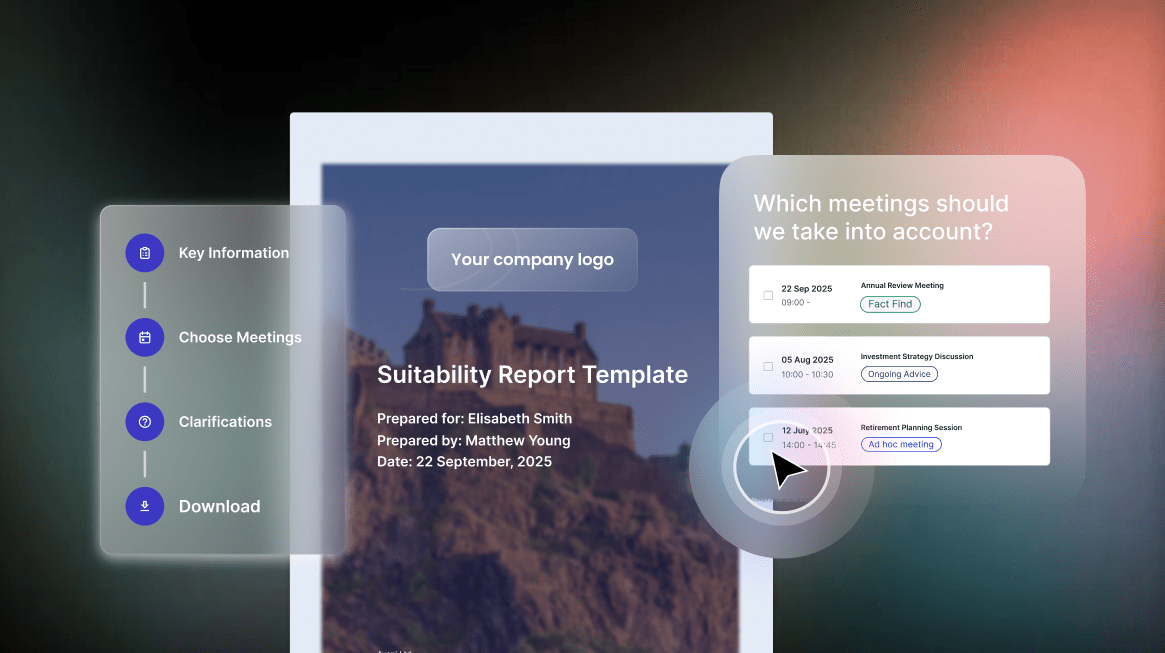
Report generation creates compliant documentation following COBS 9.4 requirements. The system populates templates with extracted information, structures content according to FCA guidance and highlights any gaps requiring adviser attention.
One 200-adviser network reduced average report creation time from 105 minutes to 15 minutes using automated suitability report writing. This generated annual savings of 15,000 hours and approximately £450,000.
Core Capabilities Required
Effective automation requires specific technical and regulatory capabilities working together.
Meeting capture technology records client conversations with appropriate consent and security. The system must handle different meeting platforms, maintain audio quality and protect client data throughout processing.
Financial services language understanding enables accurate extraction of complex advice terminology. Generic AI tools struggle with pension transfer calculations, drawdown strategies and investment platform comparisons. Domain-specific training ensures the system interprets advice conversations correctly.
Regulatory alignment means the AI understands COBS 9.4 requirements, Consumer Duty obligations and firm-specific compliance standards. Reports must meet FCA expectations for clarity, completeness and suitability justification.
Template integration allows the system to work with existing firm templates. Advisers continue using familiar formats whilst AI handles content population. This maintains consistency and reduces change management challenges.
Information Extraction Process
Automated systems identify and extract specific information categories from client meetings.
Client circumstances capture includes current financial position, income and expenditure, assets and liabilities, existing provisions and protection needs. The system notes both stated facts and contextual details affecting recommendations.
Goals and objectives extraction identifies short-term needs, medium-term plans, long-term aspirations and priorities amongst competing goals. The AI recognises implicit objectives mentioned during conversation flow.
Risk assessment information covers attitude to risk discussions, capacity for loss assessment, previous investment experience and emotional responses to market volatility scenarios. The system documents evidence supporting risk profile conclusions.
Product discussion details record features explored, alternatives considered, charges explained, benefits highlighted and client questions answered. This provides the justification trail regulators expect.
Template Population and Structure
AI-generated reports follow firm templates whilst ensuring regulatory completeness.
Executive summary sections synthesise meeting outcomes, state recommendations clearly and highlight key suitability factors. The system creates concise overviews that boards and compliance teams can review quickly.
Client circumstances documentation presents extracted information in structured format. The AI organises details logically, highlights changes from previous reviews and flags inconsistencies requiring verification.
Recommendation justification explains why proposed solutions meet identified needs, how products align with risk profile and goals, why alternatives were rejected and what benefits clients receive. The system builds clear reasoning chains supporting suitability.
Risk warnings and disclosures ensure required information appears prominently. The AI includes appropriate warnings based on product type, client circumstances and regulatory requirements.
Quality Assurance Before Adviser Review
Automated systems perform compliance checks before presenting draft reports to advisers.
Completeness verification confirms all required sections contain information, mandatory disclosures appear and critical facts from the meeting are captured. The system flags gaps preventing the report from being compliant.
Consistency checking compares meeting notes against CRM records, verifies fact-find alignment and identifies contradictions requiring resolution. When stated risk tolerance conflicts with investment history, the AI highlights the discrepancy.
Regulatory alignment review ensures language meets FCA clarity standards, risk warnings appear appropriately and suitability justification is sufficient. The system applies firm-specific compliance criteria automatically.
One wealth management firm’s AI system flags approximately 15% of draft reports for enhanced review due to detected gaps or inconsistencies. This prevents incomplete documentation from reaching clients.
Adviser Review and Finalisation
Human advisers review AI-generated drafts, make necessary adjustments and approve final reports.
Review focus shifts from writing content to verifying accuracy and completeness. Advisers check that extracted information is correct, recommendations are appropriately justified and all client questions are addressed.
Amendment capability allows advisers to refine language, add personal observations, adjust recommendations and include additional context. The system learns from these edits to improve future draft quality.
Approval workflows route completed reports through compliance checks before client delivery. Senior advisers or compliance officers review complex cases whilst straightforward reports proceed with standard approval.
Most advisers spend 10 to 15 minutes reviewing and finalising AI-generated suitability reports compared to 90 to 120 minutes creating reports manually from scratch.
Integration with Existing Systems
Automated suitability report writing connects with adviser technology ecosystems.
CRM integration pulls client data, fact-find information and previous interaction history. The AI uses this context to enrich reports and identify changes in circumstances.
Document management systems receive completed reports automatically. The system files documentation in appropriate client folders, maintains version history and triggers workflow steps.
Back-office platform connections enable straight-through processing from report approval to implementation. Product applications and transfers proceed without manual re-keying of information.
One advice network integrated automated report writing with intelliflo office. Reports generate with full CRM context, save automatically to client files and trigger product processing workflows.
Compliance and Regulatory Considerations
Automated suitability report writing must meet strict FCA requirements whilst delivering efficiency gains.
COBS 9.4 compliance requires reports to contain specific information about client circumstances, reasons for recommendations and suitability explanations. AI-generated reports must meet these standards consistently.
Consumer Duty obligations demand clear communication customers can understand. The system must avoid jargon, explain complex concepts appropriately and ensure customers can make informed decisions.
Treating Customers Fairly principles apply to automated documentation. Reports must not discriminate, must be appropriate for vulnerable customers and must support good outcomes.
Audit trails document what information the AI extracted, how it reached conclusions and what edits advisers made. This evidence supports regulatory reviews and demonstrates appropriate oversight.
Implementation Requirements
Firms need specific capabilities to deploy automated suitability report writing successfully.
Template standardisation ensures the AI can populate firm formats consistently. Reviewing and updating templates before implementation improves results from day one.
Data quality in CRM systems affects extraction accuracy. Client records should be complete, fact-finds should be current and previous interaction notes should be comprehensive.
Adviser training covers how to review AI-generated drafts efficiently, when to make adjustments and how to work with the system effectively. Proper training accelerates adoption and maximises time savings.
Governance frameworks define approval processes, quality standards and escalation criteria. Clear rules prevent incomplete reports from reaching clients whilst avoiding unnecessary delays.
Expected Time Savings
Automated suitability report writing delivers substantial productivity improvements across advice networks.
Initial suitability reports that previously required 90 to 120 minutes now take 10 to 15 minutes for adviser review and approval. This represents 85% to 90% time savings on report creation.
Annual review documentation reduces from 60 to 90 minutes to 8 to 12 minutes. Advisers handle more review meetings without increasing administrative burden.
Fund switch reports drop from 90 minutes to 20 minutes. The system updates existing documentation with new recommendations whilst maintaining full suitability justification.
One firm calculated that saving 75 minutes per suitability report across 200 advisers producing 10 reports monthly generated 30,000 hours of freed capacity annually.
Cost Considerations
Investment in automated suitability report writing includes implementation and ongoing licensing costs.
Implementation expenses cover system setup, template configuration, integration with existing platforms and adviser training. Most firms invest £30,000 to £60,000 depending on network size and complexity.
Ongoing costs include per-adviser licensing fees typically ranging from £2,000 to £4,000 annually and system support and maintenance.
ROI calculations compare costs against freed adviser time value. If an adviser generates £150,000 revenue annually and automation frees 15 hours weekly, the capacity gain is worth £60,000 to £75,000 per adviser. Against system costs of £3,000 to £4,000 per adviser, returns are substantial.
Common Implementation Challenges
Firms deploying automated suitability report writing face predictable obstacles with known solutions.
Template inconsistency across the network complicates AI training. Standardising formats before implementation prevents this issue.
Poor meeting recording quality reduces transcription accuracy. Clear guidance on microphone usage, background noise elimination and speaking clearly improves results.
Adviser resistance may emerge if staff feel judged or worry about job security. Communicating that automation handles administrative work so advisers can focus on client relationships addresses these concerns.
Incomplete fact-finds create gaps in AI-generated reports. Improving fact-find completion before automation deployment enhances draft quality.
Benefits Beyond Time Savings
Automated suitability report writing delivers advantages extending beyond productivity improvements.
Compliance consistency improves as the AI applies standards uniformly across all reports. Manual variation in quality, completeness and regulatory alignment decreases.
New adviser productivity increases as junior staff receive AI support producing high-quality documentation from their first client meetings. Training time reduces and new advisers become productive faster.
Client satisfaction improves when advisers deliver reports more quickly after meetings. Same-day or next-day documentation strengthens client relationships compared to 2 to 3 week delays from manual processes.
Regulatory confidence grows as firms demonstrate consistent, compliant documentation across their adviser population. FCA file reviews proceed smoothly when all reports meet quality standards.
Technology Evolution
Automated suitability report writing capabilities continue advancing with new features emerging.
Real-time guidance during meetings may suggest questions advisers should ask, highlight missing information and recommend products based on discussion flow. This supports better advice quality alongside documentation efficiency.
Multi-meeting synthesis could combine information from multiple client interactions into comprehensive reports. Complex advice processes spanning several meetings benefit from accumulated context.
Personalisation learning allows systems to adapt to individual adviser styles, preferred phrasing and communication approaches whilst maintaining regulatory compliance.
Frequently Asked Questions
Do AI-generated reports meet FCA requirements? Yes, when properly configured. Systems trained on financial advice and aligned with COBS 9.4 produce compliant reports consistently. Adviser review and approval maintain accountability.
How long does implementation take? Most firms achieve operational automated suitability report writing within 8 to 12 weeks including setup, integration, template configuration and adviser training.
What happens if the AI makes an error? Adviser review catches errors before reports reach clients. The system highlights areas where it has lower confidence, prompting careful human verification.
Can the system handle complex advice scenarios? Yes, for most situations. Very complex cases involving multiple products, unusual circumstances or intricate calculations may require more adviser input. The system still provides substantial time savings by handling standard sections.
Discover how Aveni Assist automates suitability report writing for financial advisers →