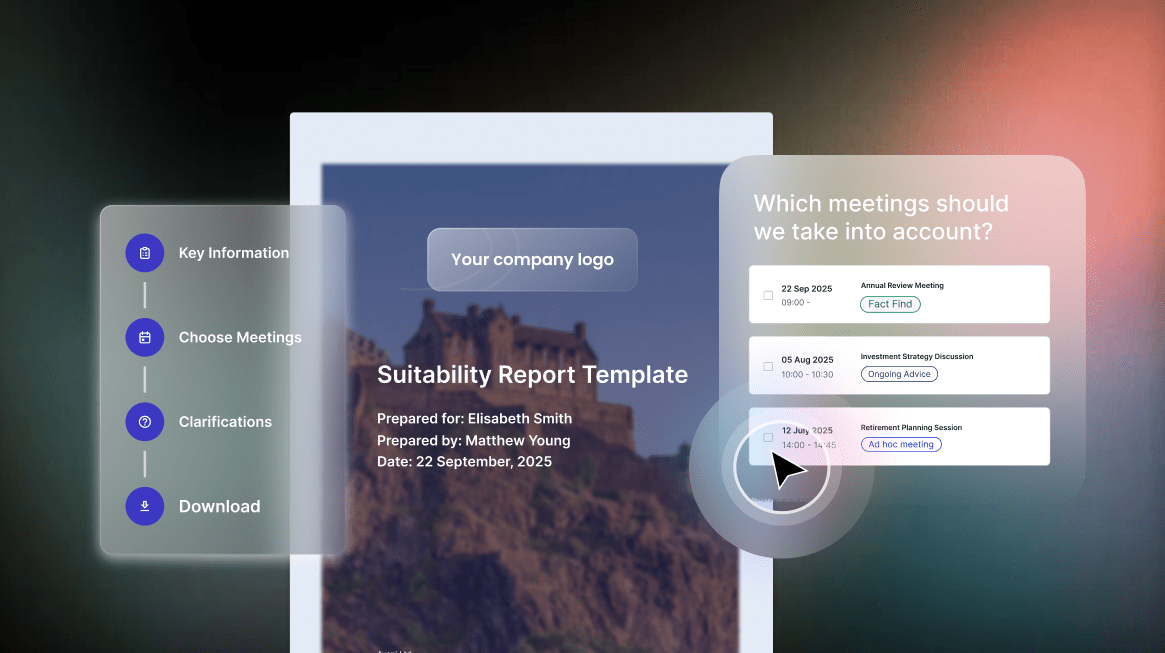


Manual suitability report creation takes 90 to 120 minutes per report for financial advisers. AI automation reduces this to 10 to 15 minutes for adviser review and approval whilst maintaining FCA compliance standards.
Manual Suitability Report Creation Time Breakdown
Financial advisers spend substantial time on suitability report writing when creating documentation manually.
Meeting notes review and organisation consumes 15 to 20 minutes. Advisers re-read handwritten or typed notes, identify key information and organise thoughts before writing begins.
Fact-find data gathering requires 10 to 15 minutes. Advisers access CRM systems, review client records and pull information needed for the report.
Template selection and setup takes 5 to 10 minutes. Advisers choose appropriate templates, create new documents and configure formatting.
Client circumstances documentation requires 20 to 25 minutes. Advisers write detailed descriptions of financial position, goals, risk tolerance and needs based on meeting discussions.
Recommendation justification takes 25 to 30 minutes. Advisers explain why proposed solutions meet client needs, how products align with circumstances and why alternatives were rejected.
Risk warnings and disclosures require 10 to 15 minutes. Advisers ensure appropriate warnings appear, regulatory language is included and client understanding is confirmed.
Proofreading and compliance checking takes 10 to 15 minutes. Advisers review for completeness, clarity and regulatory alignment before sending to clients or compliance teams.
Total time: 90 to 120 minutes per initial suitability report using manual processes.
Time Breakdown by Report Type
Different suitability report categories require varying time investments when created manually.
Initial advice suitability reports take longest at 90 to 120 minutes. These comprehensive documents require detailed client circumstances, full suitability justification and complete risk warnings.
Annual review reports require 60 to 90 minutes. Advisers update circumstances, assess ongoing suitability and document any changes. Whilst shorter than initial reports, they still demand substantial time.
Fund switch reports take 60 to 90 minutes. Advisers explain reasons for changes, justify new recommendations and update suitability documentation.
Simplified reports for straightforward cases still require 45 to 60 minutes. Even simple advice needs proper documentation meeting FCA requirements.
One advice network calculated that their 200 advisers spent 36,000 hours annually on suitability report writing across all report types using manual processes.
Automated Suitability Report Time Breakdown
AI-powered automation transforms the time required whilst maintaining quality and compliance.
Meeting capture occurs automatically during client conversations. No separate note-taking or review time is needed as the system records and transcribes discussions in real time.
Information extraction happens within minutes after the meeting ends. The AI identifies client circumstances, goals, risk profile and discussion points without manual data gathering.
Draft report generation takes 2 to 3 minutes. The system populates templates, structures content and creates compliant documentation automatically.
Adviser review and approval requires 10 to 15 minutes. Advisers verify accuracy, make any necessary adjustments and approve final reports.
Total time: 10 to 15 minutes per report with automated systems handling extraction and drafting.
Time Savings Comparison by Report Type
| Report Type | Manual Time | Automated Time | Time Saved | Savings Percentage |
|---|---|---|---|---|
| Initial suitability report | 90-120 minutes | 10-15 minutes | 75-110 minutes | 83-92% |
| Annual review report | 60-90 minutes | 8-12 minutes | 48-82 minutes | 80-91% |
| Fund switch report | 60-90 minutes | 10-15 minutes | 45-80 minutes | 75-89% |
| Simplified advice report | 45-60 minutes | 8-12 minutes | 33-52 minutes | 73-87% |
Time Savings at Network Scale
Individual adviser time savings multiply across advice networks to generate substantial capacity increases.
A 50-adviser firm where each adviser produces 8 suitability reports monthly saves 500 to 733 hours monthly through automation. Annually, this represents 6,000 to 8,800 hours of freed capacity.
A 200-adviser network producing 10 reports per adviser monthly saves 2,500 to 3,667 hours monthly. Annual savings reach 30,000 to 44,000 hours of adviser capacity.
A 500-adviser organisation with 12 reports per adviser monthly saves 7,500 to 11,000 hours monthly. This translates to 90,000 to 132,000 hours annually available for revenue-generating activities.
One firm calculated that 30,000 freed hours annually across their 200-adviser network created capacity worth £2 million to £3 million in adviser time value.
Time Impact on Adviser Productivity
Reduced report writing time enables advisers to increase client-facing activities.
More client meetings become possible when administrative burden decreases. Advisers handling 18 client meetings monthly with manual processes increase to 25 meetings with automation, a 39% capacity gain.
Faster turnaround improves client experience. Reports delivered within 24 hours of meetings strengthen relationships compared to 2 to 3 week delays from manual processes.
Same-day service becomes achievable for straightforward advice. Clients leave meetings knowing their documentation will arrive that afternoon rather than waiting weeks.
One adviser reported that automation allowed her to serve 30% more clients annually without working additional hours or compromising service quality.
Time Distribution Changes
Automation shifts how advisers allocate their working hours.
Manual process time allocation typically sees advisers spending 40% of time on client meetings, 35% on report writing and administration, 15% on technical research and planning, and 10% on business development and CPD.
Automated process time allocation shifts to 60% client meetings, 15% report review and approval, 15% technical research and planning, and 10% business development and CPD.
This redistribution redirects 20 percentage points of adviser time from administration to revenue-generating client interactions.
Quality Considerations Versus Time
Faster report creation does not compromise quality when automation is properly implemented.
Compliance consistency improves as AI applies standards uniformly. Manual reports vary in quality depending on adviser skill, experience and time pressure. Automated reports maintain consistent completeness and regulatory alignment.
Detail level remains appropriate as systems extract comprehensive information from meetings. Advisers worried that faster processes might miss details find that AI captures more information than manual note-taking.
Regulatory alignment strengthens because systems trained on FCA requirements build in appropriate language, risk warnings and suitability justification automatically.
One compliance team found automated reports required 40% fewer corrections than manual reports despite being produced in a fraction of the time.
Impact on New Adviser Productivity
Time benefits are particularly significant for junior advisers building their practices.
Experienced advisers create manual reports in 90 to 120 minutes. Junior advisers often require 120 to 180 minutes as they develop documentation skills and regulatory knowledge.
Automation reduces this to 15 to 20 minutes for junior advisers. The AI provides structure, regulatory language and compliance checking that inexperienced advisers might struggle with manually.
Training time decreases as new advisers produce compliant reports from their first client meetings. Rather than spending months learning report writing, they focus on client relationship skills.
One firm reported new advisers reached full productivity 3 to 4 months faster with automated suitability report writing support.
Cost of Manual Report Writing Time
Adviser time has direct financial value making time savings economically significant.
If an adviser generates £150,000 annual revenue and spends 35% of time on report writing, that administrative burden costs £52,500 in opportunity cost annually.
Reducing report time from 35% to 15% of working hours frees 20 percentage points worth £30,000 in capacity value per adviser annually.
Across a 200-adviser network, this capacity gain is worth £6 million annually that can be directed toward revenue growth or service quality improvements.
Implementation Time Versus Ongoing Savings
Deploying automated suitability report writing requires initial time investment that pays back quickly.
Implementation preparation takes 2 to 4 weeks including template review, system configuration and integration setup. This one-time investment involves compliance, operations and IT teams.
Adviser training requires 2 to 4 hours per adviser covering system usage, review processes and quality standards. Training can occur in group sessions or individually.
Transition period sees advisers working 20% to 30% slower for the first 2 to 3 weeks as they adapt to new processes. This temporary productivity dip reverses quickly.
One firm calculated that implementation time investment was recovered within 6 weeks through ongoing time savings across their adviser population.
Measuring Time Savings Accurately
Firms should track specific metrics to validate time improvements.
Baseline measurement captures current report creation time before automation. Track average time across multiple advisers and report types for accurate benchmarks.
Post-implementation tracking measures time from meeting end to completed report approval. Include both system processing time and adviser review time.
Comparative analysis shows time savings by report type, adviser experience level and advice complexity. This reveals where automation delivers most value.
Ongoing monitoring identifies trends suggesting system refinement opportunities. If review times increase, investigation may reveal training needs or system configuration improvements.
Beyond Time: Additional Efficiency Benefits
Time savings represent only part of automation’s productivity impact.
Context switching reduction improves adviser focus. Rather than stopping mid-day to write reports, advisers batch review tasks efficiently.
Mental fatigue decreases when advisers avoid repetitive documentation work. Fresh mental energy redirects toward complex planning and client relationship building.
Work-life balance improves as advisers complete documentation efficiently during working hours rather than writing reports in evenings or weekends.
Job satisfaction increases when administrative burden decreases. Advisers report higher career satisfaction when spending more time on meaningful client work.
Frequently Asked Questions
Do automated reports require the same review time regardless of advice complexity? No. Straightforward advice may require only 8 to 10 minutes review. Complex cases involving multiple products or unusual circumstances may need 15 to 20 minutes. This is still substantially faster than manual creation taking 90+ minutes.
How does automation affect paraplanner roles? Paraplanners shift focus from report writing to complex technical work, adviser support and quality assurance. Many firms report higher paraplanner job satisfaction after automation.
Can advisers work on reports whilst systems generate drafts? Yes. The 2 to 3 minute generation time allows advisers to handle other tasks. Most review reports in batches rather than waiting for individual drafts.
What happens if an automated report needs significant revision? Even reports requiring substantial edits save time versus manual creation. Advisers start with structured, populated templates rather than blank documents, reducing total time.
Learn how Aveni Assist reduces suitability report time from 90 to 10 minutes →