

CUSTOMER STORY • OCTOPUS MONEY

Don Stewart runs training and competence at Octopus Money. He replaced a QA process that sampled one in five client calls, ran on a Google spreadsheet, and took up to two hours a check. Detect now reviews every interaction his coaches and advisers have.

On the front line, adviser Mooka Maboshe uses Assist to clear the bulk of her weekly admin in the 15 minutes between client meetings.


Octopus Money
Financial advice & coaching
~60 advisers and coaches
Detect; Assist
THE STARTING POINT
Octopus Money serves clients across two regulated tracks: financial coaches for guidance, and wealth planners for investments, pensions and major life decisions. Every client interaction needed oversight, and the old process couldn’t keep up.
Before Detect, the team ran QA by hand. An assessor would find a call in the library, listen to it end-to-end, and complete a scoring form in Google Sheets. One check took between one and two hours.
Even at full capacity, the team could only assess 15 to 20% of calls. That meant most client conversations went unchecked, training needs were spotted at random, and Consumer Duty evidence depended on whichever calls happened to be in the sample.
Octopus Money serves clients across two regulated tracks: financial coaches for guidance, and wealth planners for investments, pensions and major life decisions. Every client interaction needed oversight, and the old process couldn’t keep up.
Before Detect, the team ran QA by hand. An assessor would find a call in the library, listen to it
end-to-end, and complete a scoring form in Google Sheets. One check took between one and two hours.
Even at full capacity, the team could only assess 15 to 20% of calls. That meant most client conversations went unchecked, training needs were spotted at random, and Consumer Duty evidence depended on whichever calls happened to be in the sample.
“Before Aveni Detect, our approach to quality assurance was basically a Google spreadsheet. It was a really manual, really laborious process.”
WHAT CHANGED
Detect runs across 100% of adviser and coach conversations. The system surfaces red-flag cases for human review, and Don’s team uses those flags as the input for targeted training.
Metric | Before | With Detect |
|---|---|---|
| Call coverage | 15–20% sample | 100% of interactions |
| Time per check | 1–2 hours, manual | 50% reduction overall |
| Vulnerability identification | Found at random in the sample | Surfaced consistently across calls |
| Training feedback loop | Delayed, anecdotal | Closed by re-running Detect on trained staff |
“Using Detect has allowed us to understand really clearly and quickly what it is that clients say that should make us think about potential vulnerability, and therefore build out a really bespoke training programme to remedy that issue.”
Don’s team triages the flags Detect raises, validates the model’s reading of each one, and aggregates the data to find which criteria recur across the population. That analysis tells him whether the issue sits with coaches, advisers, or both, and where the root cause lies in the process.
From there, training content is written against the specific behaviours Detect surfaced. After delivery, the team re-runs Detect on calls from the trained staff to confirm the change has landed.
HOW THE TEAM USES IT
The same tool that surfaces issues also verifies that training has worked. Don walked us through the four steps his team runs on a continuous basis.
Detect flags red-flag cases across the full call population. Don's team validates the system's read and aggregates the flags to find recurring criteria.
Content is written against the specific behaviours Detect surfaced. The contrast between what's happening on calls and what should happen is the brief.
The aggregated data shows whether issues sit with coaches, advisers, or both, and points to which part of the process needs to change.
After training, Detect re-runs on calls from the trained staff. Don checks the behaviours are now consistent, then closes the loop.
ADOPTION
Don rolled Aveni Detect out across roughly 60 advisers and coaches, alongside Aveni Assist for note-taking and case build. Reactions varied at first, then converged.
Early on, some staff worried the technology was there to replace them. That faded once they saw the time saved on case creation and the speed of feedback from line managers. Coaches reported a 50% time saving on case build with Assist. Advisers saw a 30% initial time saving on post-meeting admin.
The other thing Don didn’t expect was the pace of the model itself. Weekly catch-ups with the Aveni team turned business-specific terminology, scenario nuance and risk language into Detect criteria within days, not months.
Don rolled Detect out across roughly 60 advisers and coaches, alongside Assist for note-taking and case build. Reactions varied at first, then converged.
Early on, some staff worried the technology was there to replace them. That faded once they saw the time saved on case creation and the speed of feedback from line managers.
Coaches reported a 50% time saving on case build with Assist. Advisers saw a 30% initial time saving on post-meeting admin.
The other thing Don didn’t expect was the pace of the model itself. Weekly catch-ups with the Aveni team turned business-specific terminology, scenario nuance and risk language into Detect criteria within days, not months.
“The biggest surprise for me has been the speed at which an AI model can catch up with what you’re doing. We could see early on that Detect was picking up the key risk areas that would worry us.”
THE ADVISER’S VIEW
Don Stewart runs training and competence. Mooka Maboshe sees it from the client side, as an associate financial adviser at Octopus Money. Assist sits in the 15 minutes between her meetings.
As a fully virtual advice business, Octopus Money combines human advice with technology to deliver a better client experience. Assist captures meetings across Microsoft Teams, Google Meet, Zoom and Webex, automatically generates meeting summaries, and writes notes directly into Intelliflo Office and Xplan, keeping client records up to date.
Before Assist, admin was one of the most time-consuming parts of Maboshe’s week. She regularly spent half a day, sometimes a full day, updating CRM records and writing follow-up emails. Now, most of that work is completed in the 15-minute gap between client meetings. She reviews the summary, makes any edits she needs, and sends her follow-up email, with the notes already stored in the CRM.
Client meetings typically last around 45 minutes. Without having to take detailed notes throughout the conversation, Maboshe can stay fully focused on her clients. The time she has gained back is now spent preparing for meetings, keeping up with industry developments, and adding more value during every client conversation.
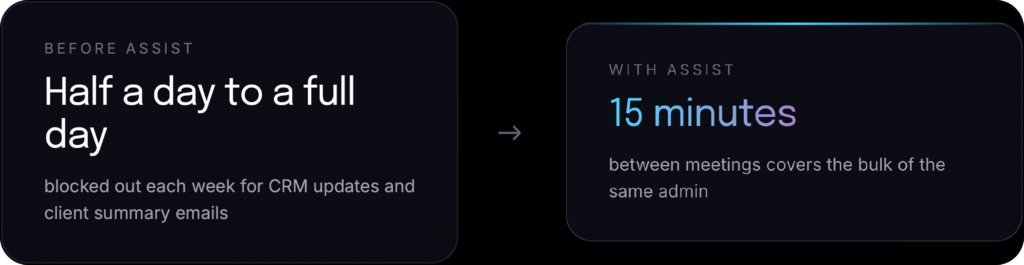
“Instead of a whole day being blocked out for various meetings in the week, within 15 minutes I could do the bulk of it.”
WHAT COMES NEXT
Octopus Money has always been an early adopter of technology, and AI in particular. Don sees Detect and Assist as the foundation for further AI applications across the business, including back-office assistants supporting onboarding and operational tasks.
His view of the broader market is direct. Firms that aren’t building AI into QA, compliance and adviser productivity will struggle to match the pace clients now expect, and the manual models that worked five years ago won’t carry forward.
For Maboshe, the point is what the technology opens up. Cutting the admin lets advisers spend more time with clients, and it puts a firm that automates the back office in front of an industry that has been slow to modernise.
Octopus Money has always been an early adopter of technology, and AI in particular. Don sees Detect and Assist as the foundation for further AI applications across the business, including back-office assistants supporting onboarding and operational tasks.
His view of the broader market is direct. Firms that aren’t building AI into QA, compliance and adviser productivity
will struggle to match the pace clients now expect, and the manual models that worked five years ago won’t carry forward.
For Maboshe, the point is what the technology opens up. Cutting the admin lets advisers spend more time with clients, and it puts a firm that automates the back office in front of an industry that has been slow to modernise.
“It’s great to be part of a business that’s doing two things: democratising financial advice, and being a leader in terms of technology.”
“Any firm that’s not currently utilising or planning to utilise AI in their process will fall behind. People expect pace nowadays. If you’re still in an antiquated manual model, you’re always going to be behind the curve.”
Detect runs across 100% of recorded client interactions. At Octopus Money, that replaced a manual sample that previously covered 15 to 20% of calls.
Octopus Money worked with the Aveni team in weekly catch-ups to refine Detect for their business language, risk criteria and conversational nuance. Don Stewart describes the speed of that adaptation as the biggest surprise of the rollout.
Octopus Money has redirected the 50% reduction in QA review time into root-cause analysis of flagged cases, bespoke training programmes built against specific behaviours, and verification that the training has embedded in adviser and coach performance.
Detect surfaces flags and aggregates patterns across the call population. Don Stewart's team still validates each flagged case, decides on training response, and signs off on outcomes. The tool supplements human judgement and scales the population that can be reviewed.
Detect flags specific language and scenarios in calls that indicate potential vulnerability. Octopus Money uses those flags to build targeted training content for advisers and coaches, then re-runs Detect on subsequent calls to verify the response has improved.
Assist captures client meetings across Microsoft Teams, Google Meet, Zoom and Webex, drafts the write-up, and writes back into Intelliflo Office and Xplan. At Octopus Money it saved coaches around 50% of case-building time and gave advisers an initial 30% saving on post-meeting admin, freeing adviser attention for the client during the session.
A 30-minute walkthrough with the team, using the same risk and Consumer Duty criteria Octopus Money uses today. Bring a sample call if you’d like to see it run live.